washington4 minutes ago
- copy link
Four astronauts aboard NASA’s Orion spacecraft are moving rapidly towards the moon. According to Indian time today, on the morning of 6th April, they have entered the gravitational field of the Moon.
Today is the most important day for this mission. Astronauts will not only see the back side of the Moon, but they will also travel far from Earth where no human has ever reached.
This mission will break the record of 400,171.18 km for the maximum distance from Earth set by Apollo 13 in 1970. These astronauts are expected to reach a distance of 402,336 km from Earth.
Complete schedule of Artemis-II flyby as per Indian time
| event | time (EST) | Time (IST) |
| Apollo-13’s record will be broken | 1:56 pm | 12:26 am |
| Astronauts’ message | 2:10 pm | 12:40 am |
| Moon observation begins | 2:45 PM | 01:15 am |
| contact will be lost | 6:44 pm | 05:14 AM |
| closest to the moon | 7:02 PM | 05:32 AM |
| maximum distance from earth | 7:07 PM | 05:37 AM |
| reconnecting with earth | 7:25 pm | 05:55 am |
| solar eclipse | 8:35 PM | 07:05 AM |
| Moon observation ends | 9:20 pm | 07:50 am |
Note: There is a difference of 10 hours 30 minutes between EST i.e. Eastern Standard Time and IST Indian Standard Time. EST time is April 6. IST time is 7th April.
There will be photography of the dark part of the moon
NASA has sent the crew a list of 30 special targets on the lunar surface, which they have to photograph and observe. The most prominent among these is the ‘Oriental Basin’, which is a crater about 600 miles wide.
It was formed by the impact of a large meteorite 3.8 billion years ago. Apart from this, they will also study the ‘Hertzsprung Basin’ to understand how the surface of the moon changes with time.
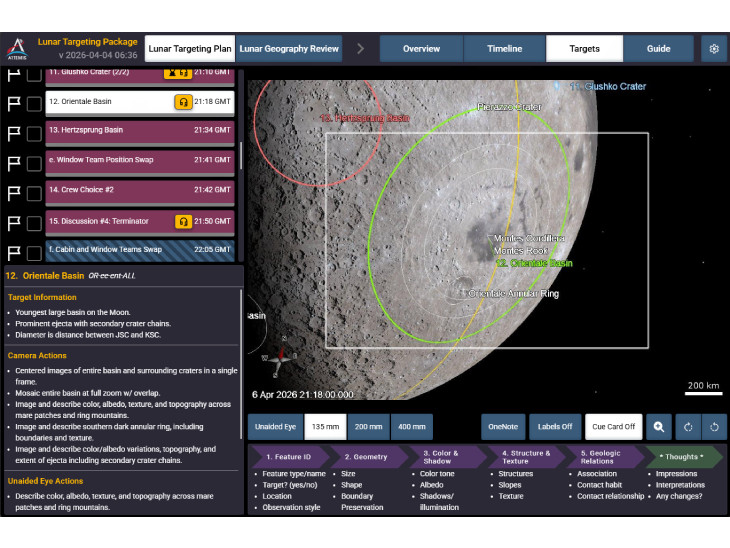
This is a screenshot of the application that the Artemis II crew sees on their PCDs. This software guides them in completing the scientific observation plan related to the moon.
This special software has been created by the ‘Crew Lunar Observation Team’, which is a part of the Lunar Science Team of Artemis II. In this screenshot you can see the ‘Oriental Basin’ on the bottom right side of the moon, on which target number 12 is circled. Target No. 13, ‘Hertzsprung Basin’, is visible to its left.
Seventh day: The spacecraft will return to Earth due to the gravity of the moon.
After coming out of the gravitational field of the Moon, the vehicle will start its journey back towards the Earth. Artemis-2’s path is largely similar to that of the Apollo-13 mission of the 1970s.
It will use the Moon’s gravity as a ‘slingshot’, which will push the spacecraft back towards Earth. In the entire mission, the four astronauts will travel about 11.02 lakh km.
Tenth day: The vehicle will fall in the Pacific Ocean on April 10.
According to Indian time, Orion will enter the Earth’s atmosphere at 6:30 am on April 11. At 6:36 pm it will ‘splashdown’ in the Pacific Ocean near San Diego. After this there will be a press conference in Houston, in which information about the mission will be given.
Purpose: NASA wants to investigate ‘life support system’
The purpose of the mission is to investigate the ‘life support system’ of the spacecraft. NASA wants to see how safe it is for humans to live in space. The vehicle will not land on the surface of the Moon now, but will make it easier for humans to settle on the Moon in the future.
4 Astronauts: For the first time a woman will reach near the moon
The mission includes three astronauts from NASA and one from the Canadian Space Agency (CSA).
1. Reed Wiseman: Wiseman (50), a former US Navy test pilot, is the mission commander. Wiseman, who spent six months on the space station in 2014, is afraid of heights above the ground. After losing his wife in 2020, Wiseman is raising his two daughters alone.
2. Christina Koch: Engineer and physicist Christina Koch (47) is the mission specialist. She holds the record for the longest stay in space by a woman (328 days). In his childhood, he had decided to become an astronaut after seeing the ‘Earthrise’ photo taken of Apollo-8.
3. Jeremy Hanson: Former Canadian fighter pilot Jeremy Hanson (50) is a mission specialist. If everything goes according to plan, Hanson will become the first non-American to reach the moon through this mission. Hanson took with him Canada’s famous maple syrup and cookies.
4. Victor Glover: Glover (49), selected as the pilot for the mission, will be the first black person to reach close to the moon. Glover has taken with him a Bible and his wedding rings. They say that the true meaning of being human is to discover and learn your place in the universe. Big difference between Apollo and Artemis programs
The main objective of the Apollo mission in the 70s was to prove itself better in the ongoing ‘space race’ with the Soviet Union. But the Artemis program is entirely a preparation for the future.
This time NASA wants to build a permanent base on the moon, so that humans can learn to work by living there. This experience will help in fulfilling the dream of going to Mars in future.
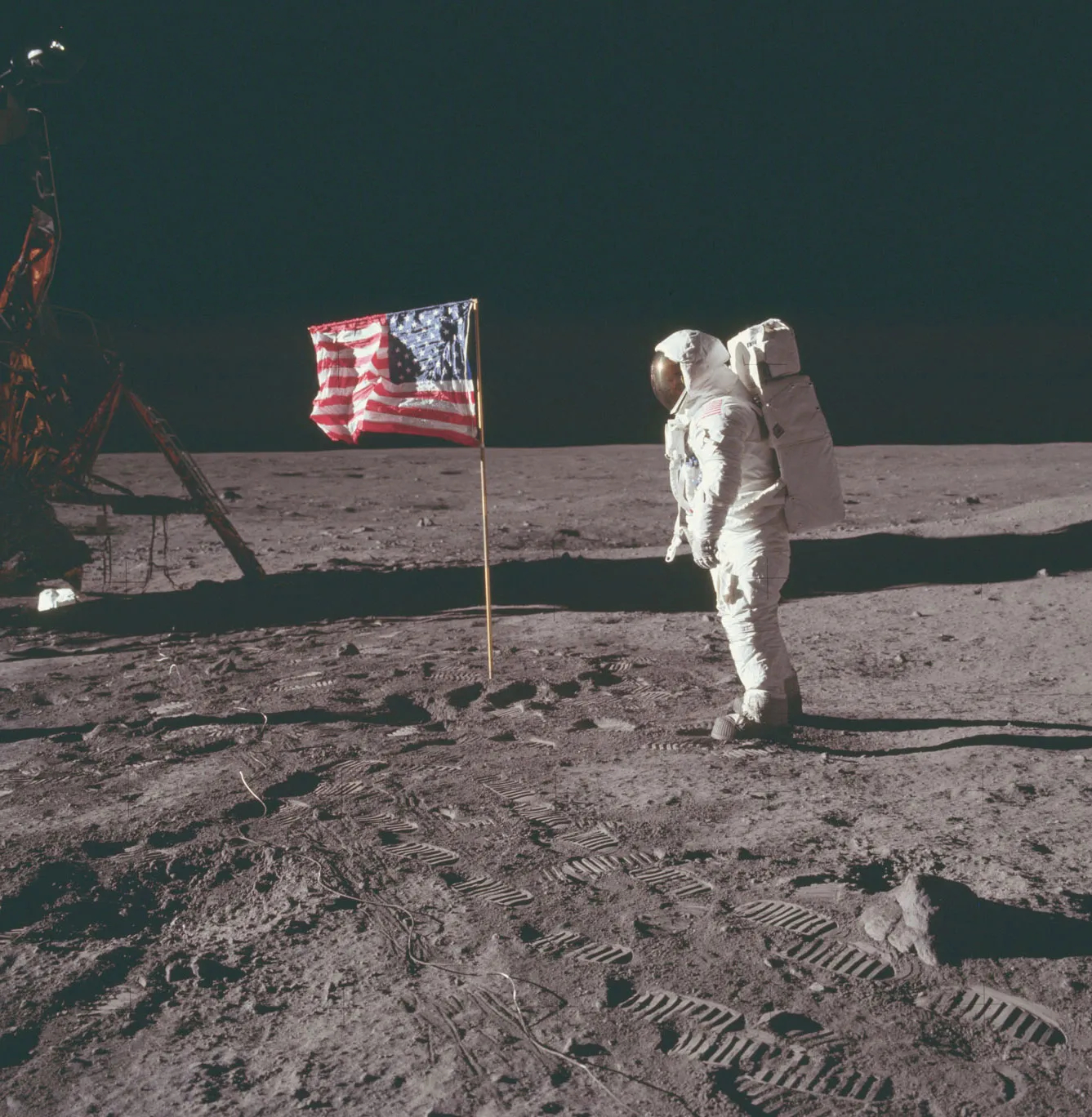
Astronaut Buzz Aldrin standing near the American flag on the surface of the Moon in 1969.
Knowledge Part:
- Till now only 24 people have been able to reach near the moon or its surface. They were all American astronauts. All were part of the Apollo missions that ran between 1968 and 1972.
- There were a total of 17 missions in NASA’s ‘Apollo Programme’, including crewed and uncrewed ones. If we talk only about the main missions in which astronauts were involved, there were 11 of them.