
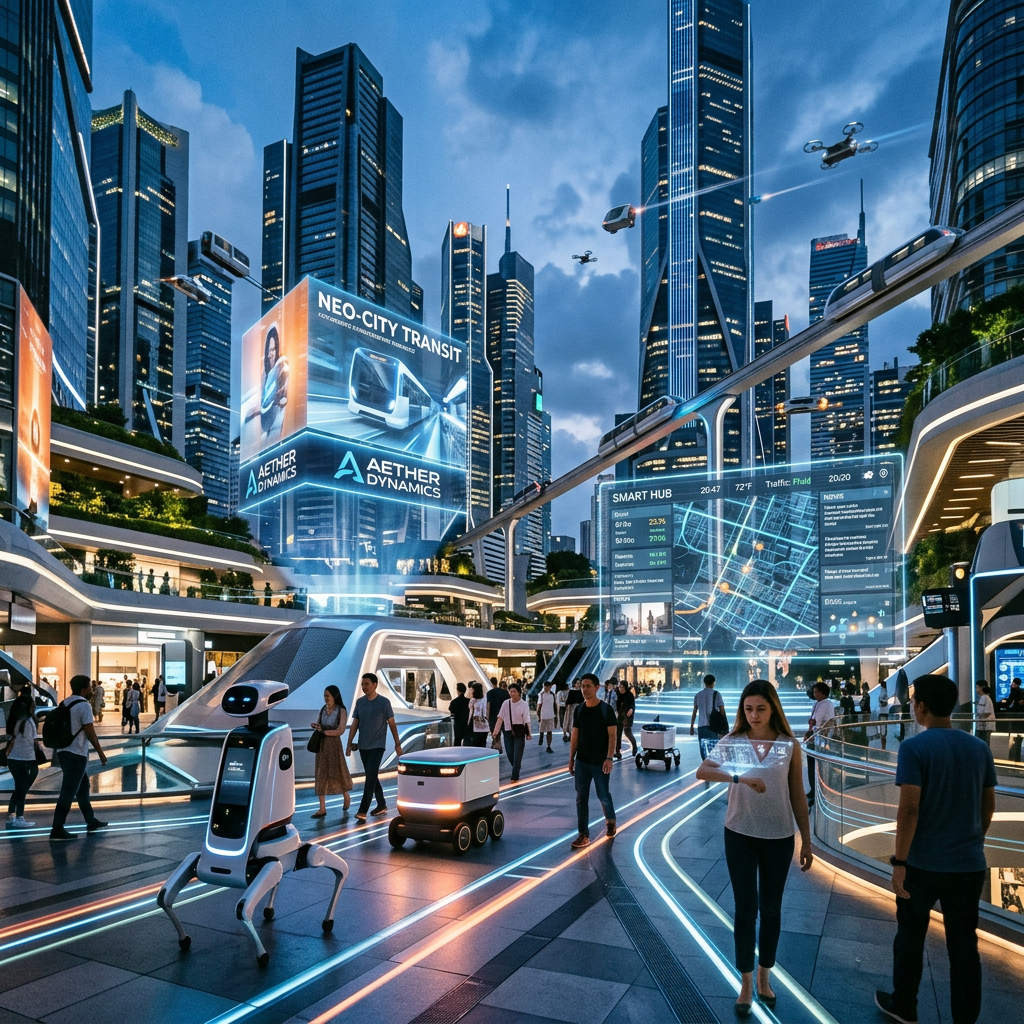
Biggest AI Trends in 2026
AI Trends to Watch in 2026 Artificial Intelligence is no longer a futuristic concept—it’s now the engine powering businesses, healthcare, education, finance, entertainment, and even our daily lives. In 2026, AI has entered a new era where intelligent systems don’t just answer questions; they complete complex tasks, make decisions, automate businesses, create content, and work alongside humans.
From AI-powered personal assistants to autonomous robots, from advanced medical diagnosis to hyper-personalized customer experiences, artificial intelligence is reshaping nearly every industry.
Companies like OpenAI, Google, Microsoft, NVIDIA, Meta, Anthropic, Amazon, Apple, and countless startups are investing billions of dollars into AI research, making 2026 one of the most exciting years in technology history.
Whether you’re a blogger, developer, entrepreneur, marketer, student, or investor, understanding the latest AI trends can help you stay ahead of the competition.
In this comprehensive guide, we’ll explore the biggest AI trends in 2026, the technologies driving innovation, and how these advancements will impact businesses and everyday life over the coming years.
Table of Contents
- AI Agents Become Everyday Assistants
- Multimodal AI Takes Over
- AI Search Replaces Traditional Search Engines
- AI in Healthcare
- AI Coding Assistants
- Robotics Revolution
- AI Cybersecurity
- AI Video Generation
- AI in Education
- AI Business Automation
- AI Hardware Boom
- AI Regulations
- Future Predictions
- FAQs
Why AI Is Growing Faster Than Ever
Artificial intelligence adoption has accelerated dramatically over the past few years. What started with simple chatbots has evolved into highly intelligent systems capable of reasoning, planning, coding, creating videos, analyzing medical data, and performing tasks that previously required human expertise.
Several factors are fueling this rapid growth:
- More powerful AI chips
- Larger and smarter language models
- Affordable cloud computing
- Better internet infrastructure
- Massive business investment
- Open-source AI innovation
- Increasing demand for automation
Businesses worldwide are integrating AI into their daily operations to reduce costs, improve productivity, and enhance customer experiences.
As AI becomes more accessible, even small businesses and independent creators can leverage powerful AI tools that were once available only to large corporations.
1. AI Agents Become the Biggest Trend of 2026
One of the most significant developments in 2026 is the rise of AI agents.
Unlike traditional chatbots that simply answer questions, AI agents can perform entire workflows independently.
For example, an AI agent can:
- Schedule meetings
- Send emails
- Analyze spreadsheets
- Research competitors
- Generate reports
- Book travel
- Build websites
- Create marketing campaigns
- Manage customer support
- Monitor business analytics
These systems combine reasoning, memory, planning, and tool usage to accomplish multi-step tasks with minimal human intervention.
Businesses are increasingly deploying AI agents to automate repetitive work, freeing employees to focus on higher-value activities.
Experts predict that AI agents will become as common in offices as email and spreadsheets within the next few years.
Why AI Agents Matter
AI agents represent a shift from passive assistants to active collaborators.
Instead of asking AI multiple questions step by step, users simply define a goal, and the AI figures out the necessary actions.
Imagine saying:
“Create a blog post, design images, optimize SEO, publish it, and share it on social media.”
Modern AI agents are beginning to perform entire workflows like this with minimal supervision.
For businesses, this means:
- Lower operational costs
- Faster decision-making
- Increased productivity
- 24/7 automation
- Improved customer service
2. Multimodal AI Becomes the New Standard
Earlier AI systems specialized in one type of content—either text, images, or audio.
In 2026, multimodal AI combines all these capabilities into a single intelligent system.
Users can now interact with AI using:
- Text
- Images
- Voice
- Video
- Documents
- Screenshots
- Live camera input
For example, a user can upload a photo of a broken appliance and ask the AI:
“What’s wrong with this?”
The AI can analyze the image, identify the issue, explain the problem, recommend replacement parts, and even generate repair instructions.
This seamless integration of multiple data types makes AI more intuitive and useful across a wide range of applications.
Real-World Applications of Multimodal AI
Multimodal AI is already transforming industries:
Healthcare
Doctors can combine medical images, patient records, and lab results for more accurate diagnoses.
Education
Students can learn through interactive conversations, diagrams, videos, and real-time explanations.
Customer Support
Support teams can analyze screenshots, voice recordings, and written descriptions simultaneously to resolve issues faster.
Marketing
Businesses can generate complete campaigns—including text, images, videos, and social media posts—from a single prompt.
Accessibility
AI can help visually impaired users by describing surroundings through live camera feeds and spoken explanations.
3. AI Search Is Replacing Traditional Search
Search engines are evolving rapidly.
Instead of presenting users with a list of blue links, AI-powered search systems now provide direct, conversational answers that summarize information from multiple sources.
This shift is changing how people discover information online and how websites attract visitors.
For publishers and bloggers, success increasingly depends on creating original, trustworthy, and in-depth content that AI systems recognize as authoritative.
How Website Owners Can Adapt
To stay competitive in AI-driven search:
- Publish unique research and insights.
- Use clear headings and structured content.
- Add FAQs that answer common user questions.
- Keep articles updated regularly.
- Build topical authority by covering related subjects in depth.
- Focus on user experience with fast-loading pages and mobile-friendly design.
Websites that consistently provide value are more likely to earn visibility in both traditional search results and AI-generated answers.
4. AI Revolutionizes Healthcare
Healthcare is one of the industries experiencing the most profound transformation through artificial intelligence. In 2026, AI is helping hospitals, clinics, and healthcare providers deliver faster, more accurate, and more personalized care.
Modern AI systems can analyze vast amounts of medical data—including X-rays, MRIs, CT scans, blood test results, and electronic health records—in seconds. This allows doctors to identify diseases earlier and make more informed decisions.
Key AI Applications in Healthcare
Early Disease Detection
AI-powered diagnostic tools can identify signs of conditions such as:
- Cancer
- Heart disease
- Stroke
- Alzheimer’s disease
- Diabetes
- Lung disorders
Earlier detection often leads to better treatment outcomes and lower healthcare costs.
Personalized Treatment Plans
AI analyzes a patient’s genetics, medical history, lifestyle, and medications to recommend customized treatment plans instead of one-size-fits-all solutions.
Virtual Healthcare Assistants
Hospitals increasingly use AI assistants to:
- Schedule appointments
- Answer patient questions
- Provide medication reminders
- Monitor chronic conditions
- Support post-surgery recovery
Drug Discovery
Developing a new medicine traditionally takes years. AI accelerates this process by analyzing millions of chemical compounds and predicting which ones are most likely to become effective treatments.
Why This Matters
Healthcare providers benefit from:
- Faster diagnoses
- Reduced workload
- Improved patient outcomes
- Better resource management
- Lower operational costs
Patients benefit from quicker access to care, more accurate diagnoses, and personalized treatment options.
5. AI Coding Assistants Become Every Developer’s Partner
Software development has changed dramatically. AI coding assistants now help programmers write, debug, optimize, and document code much faster than before.
Rather than replacing developers, AI acts as an intelligent partner that increases productivity.
What AI Coding Tools Can Do
Modern coding assistants help with:
- Writing code from natural language
- Debugging errors
- Explaining complex code
- Refactoring outdated projects
- Creating documentation
- Generating test cases
- Translating code between programming languages
Developers can now describe what they want in plain English, and AI generates a working code foundation within seconds.
Benefits for Businesses
Companies are seeing significant improvements in software development by using AI:
- Faster product launches
- Reduced development costs
- Improved code quality
- Fewer programming errors
- Increased developer productivity
Even beginner programmers can learn faster by using AI to explain coding concepts and best practices.
6. Robotics Powered by AI Enters the Real World
Robots are becoming smarter thanks to advances in artificial intelligence. Instead of performing only repetitive factory tasks, AI-powered robots can now understand environments, recognize objects, make decisions, and interact with people.
Industries Using AI Robots
Manufacturing
Factories use intelligent robots for:
- Assembly
- Quality inspection
- Packaging
- Equipment maintenance
- Logistics
Warehouses
AI-powered robots:
- Pick products
- Organize inventory
- Transport goods
- Assist workers safely
Agriculture
Farmers use AI robots for:
- Crop monitoring
- Precision spraying
- Harvesting
- Soil analysis
Hospitality
Hotels and restaurants use robots for:
- Room delivery
- Cleaning
- Customer assistance
- Food service
Home Robotics
Consumer robots continue improving with smarter navigation and automation.
Examples include:
- Robotic vacuum cleaners
- Lawn maintenance robots
- Smart home assistants
- Elder care robots
- Educational robots
As AI becomes more affordable, intelligent robots are expected to become common household devices.
7. AI Strengthens Cybersecurity
Cybersecurity threats continue to evolve, making AI an essential defense tool.
Traditional security systems rely on predefined rules. AI systems continuously learn from new threats and detect suspicious behavior in real time.
AI Security Features
Artificial intelligence helps organizations:
- Detect phishing attacks
- Prevent ransomware
- Identify malware
- Monitor unusual network activity
- Block fraudulent transactions
- Protect sensitive customer data
AI can analyze billions of events daily—far beyond what human analysts could process.
AI vs AI
Interestingly, cybercriminals also use AI to automate attacks.
As a result, cybersecurity is becoming a battle between defensive AI and offensive AI.
Organizations investing in AI-powered security gain faster threat detection and stronger protection against increasingly sophisticated attacks.
8. AI Video Generation Explodes
One of the fastest-growing AI trends in 2026 is video generation.
Businesses, educators, marketers, and content creators now use AI to produce professional-quality videos from simple text prompts.
AI Video Capabilities
Modern AI can generate:
- Marketing videos
- Product demonstrations
- Social media reels
- Educational lessons
- Training materials
- Animated explainers
- News summaries
Instead of hiring large production teams, businesses can create engaging video content within minutes.
Why Video AI Is Growing
Video remains one of the most engaging content formats online.
AI helps creators:
- Save production costs
- Publish more frequently
- Localize content into multiple languages
- Add realistic voiceovers
- Generate subtitles automatically
- Produce personalized videos for different audiences
This trend is expected to reshape digital marketing and online education.
9. AI Changes Education Forever
Education is becoming more personalized thanks to artificial intelligence.
Instead of every student learning at the same pace, AI systems adapt lessons to individual strengths and weaknesses.
AI in Classrooms
Educational platforms now provide:
- Personalized learning paths
- Instant homework assistance
- Interactive tutoring
- Language learning
- Exam preparation
- Writing feedback
- Coding practice
Students receive explanations tailored to their current level of understanding.
Benefits for Teachers
Teachers use AI to:
- Create lesson plans
- Grade assignments
- Generate quizzes
- Track student progress
- Identify struggling learners
- Reduce administrative work
Rather than replacing teachers, AI allows educators to spend more time supporting students directly.
10. AI Business Automation Becomes Essential
Businesses of every size are adopting AI automation to improve efficiency and reduce costs.
AI now manages many routine business operations without constant human supervision.
Common Business Uses
Organizations automate:
- Customer support
- Email management
- Data entry
- Invoice processing
- HR recruitment
- Marketing campaigns
- Sales forecasting
- Inventory management
- Financial reporting
These automations reduce repetitive work while improving accuracy.
Benefits for Small Businesses
AI is no longer limited to large corporations.
Small businesses now use affordable AI tools to:
- Build websites
- Write blog posts
- Design graphics
- Manage social media
- Generate invoices
- Analyze customer behavior
- Improve SEO
- Create advertising campaigns
This levels the playing field, allowing startups and entrepreneurs to compete more effectively with larger companies.
11. AI Hardware Boom Powers the Next Generation
Artificial intelligence has become so powerful that traditional computer hardware is no longer enough. In 2026, demand for AI chips, high-performance GPUs, and specialized processors continues to grow as businesses train larger AI models and deploy AI applications at scale.
Modern AI workloads require enormous computing power to process billions of parameters efficiently. This has led to rapid innovation in AI hardware from leading technology companies.
Key Hardware Trends
AI GPUs
Graphics Processing Units (GPUs) remain the backbone of AI training and inference. They enable faster model training, image generation, video processing, and large language model deployment.
AI PCs
A new generation of AI-powered laptops and desktop computers includes dedicated Neural Processing Units (NPUs), allowing users to run AI features locally with improved privacy and performance.
Edge AI Devices
Instead of sending all data to the cloud, many AI systems now process information directly on smartphones, cameras, vehicles, and IoT devices. This reduces latency and enhances security.
Data Center Expansion
Cloud providers continue investing heavily in AI-ready data centers to meet the growing demand for enterprise AI services.
Why AI Hardware Matters
Better hardware enables:
- Faster AI responses
- Lower operational costs
- Reduced energy consumption
- Improved security through local processing
- More accessible AI for businesses of all sizes
The continued evolution of AI hardware will be essential for supporting increasingly capable AI systems.
12. AI Governance, Ethics, and Regulation
As AI becomes more influential in society, governments and organizations are placing greater emphasis on responsible AI development.
In 2026, AI governance is a major priority, with efforts focused on ensuring that AI systems are safe, transparent, fair, and accountable.
Key Areas of Focus
Transparency
Organizations are expected to disclose when AI is used to generate content or make decisions.
Privacy
AI developers are strengthening data protection practices to safeguard personal information and comply with evolving privacy regulations.
Bias Reduction
Developers are working to minimize unfair bias in AI systems by improving training data quality and testing models across diverse scenarios.
Human Oversight
For high-impact decisions—such as healthcare, finance, or legal matters—human review remains essential to ensure accountability.
Why Responsible AI Is Important
Responsible AI helps:
- Build public trust
- Improve reliability
- Reduce harmful outcomes
- Support regulatory compliance
- Encourage long-term innovation
Organizations that adopt ethical AI practices are likely to earn greater confidence from customers and partners.
13. Green AI and Sustainable Computing
As AI models become larger and more complex, energy consumption has become an important consideration.
Green AI focuses on developing efficient models and infrastructure that reduce environmental impact while maintaining strong performance.
Sustainable AI Practices
Companies are investing in:
- Energy-efficient AI chips
- Optimized algorithms
- Renewable energy for data centers
- Model compression techniques
- Smarter resource allocation
These innovations help lower costs and reduce the carbon footprint of AI technologies.
14. The Future of AI: Predictions for 2027–2030
While no one can predict the future with certainty, several trends are likely to shape the next phase of AI development.
AI Will Become More Personalized
Future AI systems will better understand individual preferences, helping users with work, education, health, and daily planning.
Greater Collaboration Between Humans and AI
Rather than replacing people, AI is expected to become a collaborative tool that enhances productivity and creativity across professions.
Smarter Automation
Businesses will automate increasingly complex workflows, allowing employees to focus on strategic and creative tasks.
Advances in Science and Research
AI is expected to accelerate discoveries in medicine, climate science, materials engineering, and other research fields by analyzing vast datasets more efficiently.
Challenges That Still Need Attention
Despite its rapid progress, AI also presents ongoing challenges:
- Misinformation and deepfakes
- Data privacy concerns
- Security risks
- Algorithmic bias
- Workforce reskilling
- Responsible governance
Addressing these issues will require cooperation between governments, technology companies, researchers, and society.
Frequently Asked Questions (FAQ)
What is the biggest AI trend in 2026?
AI agents capable of completing multi-step tasks independently are among the most significant trends, alongside multimodal AI and AI-powered automation.
Which industries benefit most from AI?
Healthcare, finance, manufacturing, education, retail, logistics, cybersecurity, and marketing are among the sectors seeing the greatest impact.
Will AI replace human jobs?
AI will automate some repetitive tasks, but it is also expected to create new roles and increase demand for skills in AI management, development, and oversight.
Is AI safe to use?
AI can be highly beneficial when developed and used responsibly, with appropriate safeguards, transparency, and human oversight.
Why is multimodal AI important?
It enables AI to understand and work with text, images, audio, video, and other data types together, making interactions more natural and effective.
Conclusion
Artificial intelligence is no longer an emerging technology—it has become a fundamental driver of innovation across industries. In 2026, advancements in AI agents, multimodal systems, healthcare, cybersecurity, robotics, education, and business automation are transforming how people live and work.
At the same time, responsible AI governance, privacy, and sustainability are becoming increasingly important to ensure that AI benefits society as a whole.
For businesses, creators, and professionals, staying informed about these trends is essential. Those who embrace AI thoughtfully and continue learning will be well positioned to thrive in the years ahead.
As AI continues to evolve, one thing is clear: the future will be shaped not only by smarter technology but also by how humans choose to use it.