
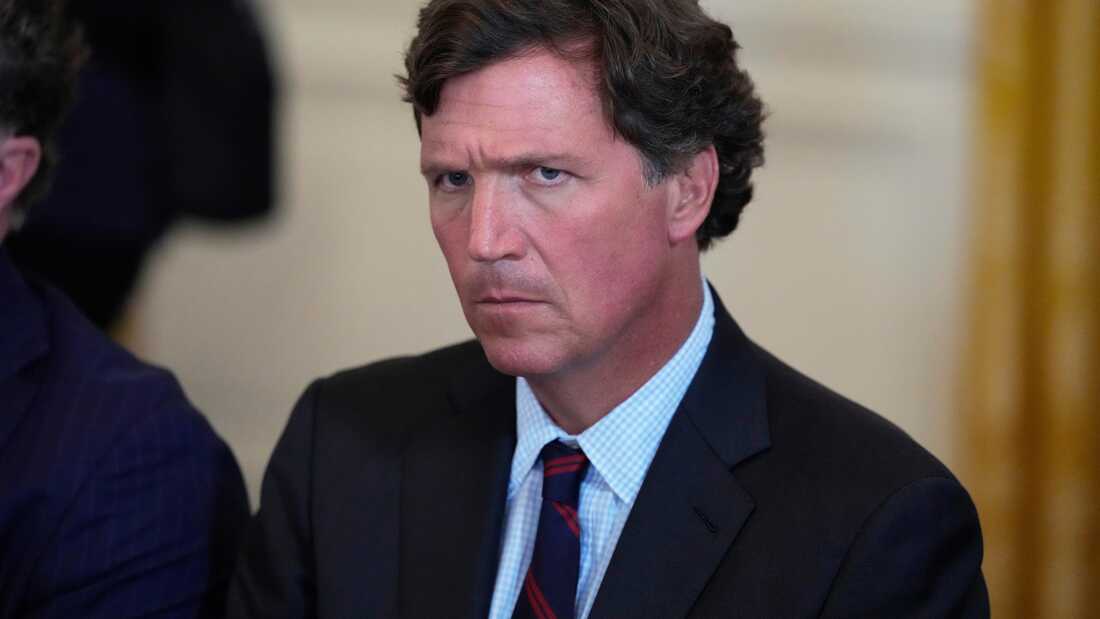

Tucker Carlson attends a meeting with President Donald Trump and oil executives in the East Room of the White House on Jan. 9, 2026.
Alex Brandon/AP Photo
hide caption
toggle caption
Alex Brandon/AP Photo
When Donald Trump first announced that he was running for president in 2015, Tucker Carlson, then the host of Fox & Friends Weekend, was one of the few pundits who took his candidacy seriously.
“[Carlson] recognized that a nativist candidate running on white grievance actually might do pretty well in a Republican primary,” New Yorker writer Jason Zengerle says. “His star rose at Fox because he kind of had the foresight to see Trump coming.”
In his new book, Hated by All the Right People: Tucker Carlson and the Unraveling of the Conservative Mind, Zengerle traces Carlson’s ascendency, and explains how he became one of the most influential people on the far right.
“He is someone that Donald Trump definitely listens to, definitely wants to hear from. And Carlson is more than happy to provide his thoughts and his advice,” Zengerle says. “That doesn’t mean that Trump always takes that advice, and there have certainly been instances where Carlson’s been disappointed by some of Trump’s decisions, but he seems to have a seat at the table.”

Carlson got his start in conservative print media and transitioned to TV in the early days of cable news. After he was let go from CNN and MSNBC (now MS NOW), he was hired by Fox, then abruptly fired in 2023. He has since launched a new streaming show on the social media platform X, where he’s espoused far-right fringe positions, such the “great replacement” conspiracy theory.
“Since leaving Fox, he doesn’t have a built-in audience anymore and he has to navigate the attention economy. And in order to get people to listen to his podcast, I think he has kind of embraced more outrageous views,” Zengerle says. “He’s saying things before in a more explicit fashion, whereas in the past he tried to modulate his rhetoric a little bit.”

Zengerle sees the throughline of Carlson’s career as a desire for “fame, fortune and power.” To that end, he would not be surprised if Carlson ran for office himself.
“It’s a mistake to think of him as just a media figure because I think his ambitions are bigger than that,” Zengerle says. “He operates as a political actor, maybe even more than a media actor at this point.”
Interview highlights

Hated By All The Right People: Tucker Carlson and the Unraveling of the Conservative Mind, by Jason Zengerle
Penguin Random House
hide caption
toggle caption
Penguin Random House
On Carlson’s shift from print journalism to TV in the ’90s
The things that he was good at, in terms of being glib and having an opinion on everything and just being able to appear reasonably intelligent on camera, that was the start of his career. … He would spend all this time and energy crafting these [print] stories, and it might get a little bit of a response. And then he would go on some TV show and make some off-handed remark, and a cabinet member would call him to talk about it. And I think that it was that sort of recognition that made him think that TV was the way to go.
On Jon Stewart‘s 2004 appearance on CNN’s Crossfire, which led to the show’s cancellation
I think [it] was a really important moment in Tucker’s career and life, because it was a humiliation. He was sort of friendly with Stewart. … He knew, obviously, that Stewart had kind of a dim view of Crossfire and a dim view of cable news. But they all thought they were kind of … play acting the way Crossfire was, you know? You would argue with this person for 30 minutes and then afterwards you’d go out and have a steak and a drink and everybody was sort of doing the same thing, and it was like professional wrestling in some ways. When Stewart came on there and wasn’t part of that game, I think Tucker was really surprised and he tried to debate Stewart and Stewart just destroyed him, and destroyed him in front of a studio audience. … It led to the cancellation of the show. It led to Tucker leaving CNN.

I think it was a really important moment in his life and his career because he was a member in good standing of the Washington political and media elite, and I think he felt that his friends in that world did not come to his aid and did not support him the way he would have wanted them to. And so years later, when he developed this populist streak and really turned against people in Washington and legacy media and the things like that, I think he remembered that moment and some of his bitterness towards those people really came out at that point.
On Carlson co-founding the conservative website The Daily Caller in 2010 and pivoting from reporting to tabloidy content
When he launched The Daily Caller, his idea for it was it was going to be a right-wing version of sort of a combination [of] Huffington Post and New York Times. He wanted it to be a very fact-based, heavily reported website. He had a critique of conservative media that conservatives didn’t report, they just opined and, “We need to get back to reporting. We need to get back to presenting facts, and we need to be serious about the news.” And that was his vision for The Caller. I think within a couple months, looking at the website’s traffic, he realized that there was not an audience for that kind of conservative publication — and he pivoted, and he kind of went more in the direction of tabloidy, kind of outrageous stuff.
Increasingly, I think he saw that the types of stories that were getting attention, that were [getting] a lot of traffic, getting clicks, had to do with race, had to do with immigration, and had to do with gender, and he just leaned into that. Eventually he kind of found himself in this competition with Breitbart that Steve Bannon was running at the time. And it was just kind of this race to the bottom in terms of who could write more kind of inflammatory and incendiary stories about Black-on-white crime or about immigrant crime and things like that. And he saw that there was an audience there for that.
On Carlson climbing the ranks at Fox
He really was kind of an afterthought at Fox. You had the stars, you had the Bill O’Reillys, you had the Sean Hannitys. Tucker was just this guy who they could put on the weekend Fox & Friends show and he had some television experience. He was conservative, so he wasn’t going to say anything that veered from the party line. He was just kind of a bit player. …

Then he got his own show, and he got his own show because he was able to use Trump’s presidential candidacy to revive his career. … When Trump came along, those more prestigious Fox shows, they had a basic television problem. They could not find camera-ready, intelligent human beings to go on their programs and make a sensible case for Donald Trump. And Tucker was someone who could, so … he started getting more airtime that way. And then as Trump’s candidacy took off and it became clear that Trump was going to be the Republican nominee. … By the end of the campaign, [Fox News CEO] Roger Ailes had been fired because of the sexual harassment scandal. [News Corps CEO] Rupert Murdoch was now running the network. And the first big move Murdoch made was taking Tucker and giving him his own show at 7 p.m.
Thea Chaloner and Susan Nyakundi produced and edited this interview for broadcast. Bridget Bentz, Molly Seavy-Nesper and Brett Neely adapted it for the web.