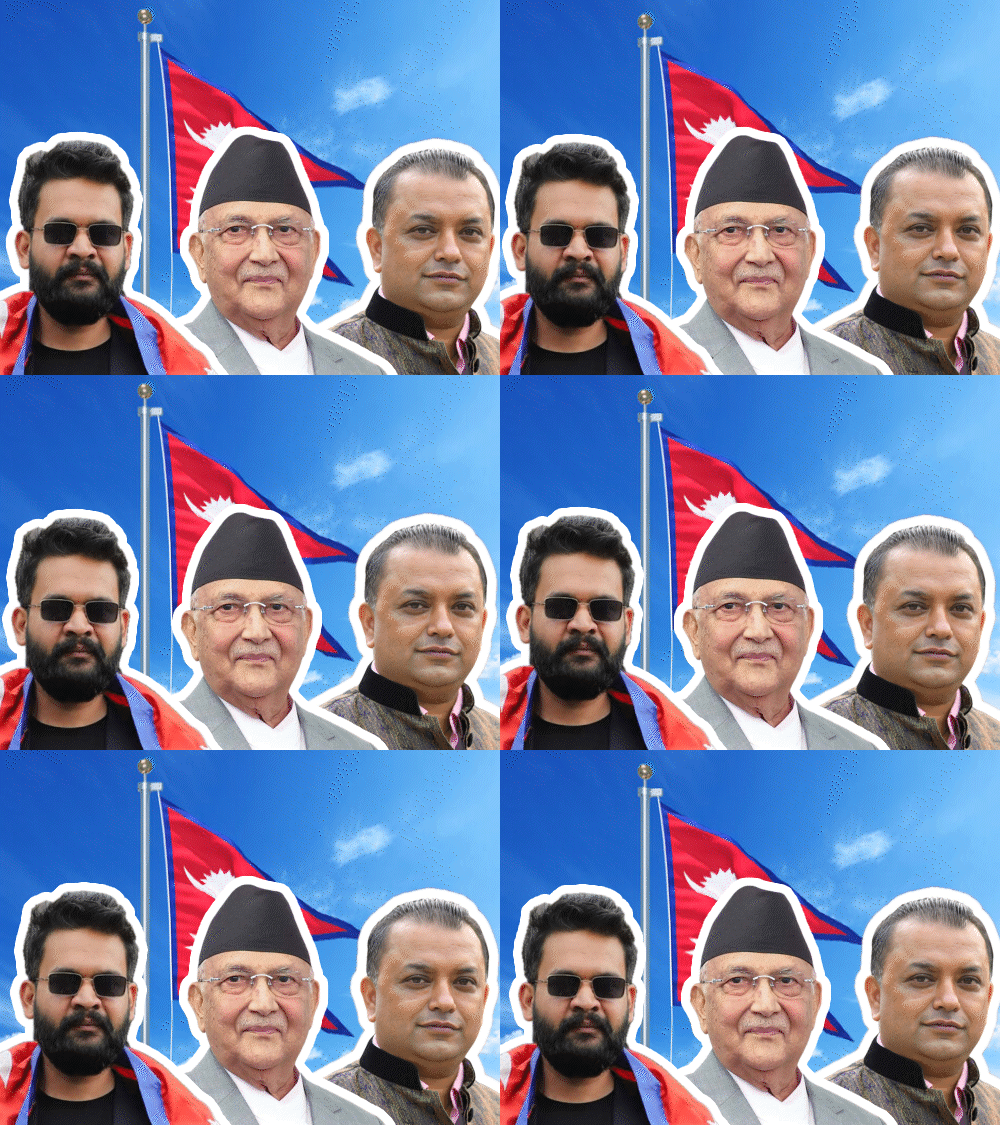
More than 60% people voted in the elections held on Thursday after the violent protests in Nepal in September last year. Counting of votes has started. Counting of votes is expected to take 3 to 4 days. It may take a week to get complete results. The Election Commission has said that efforts will be made to complete the counting by March 9. The results of 165 seats with direct elections can be released within 24 hours of the start of counting of votes. It may take two to three more days to complete the counting of all 275 seats. Rapper and former mayor of Kathmandu Balen Shah and Gagan Thapa are being considered as the main contenders for the post of Prime Minister in the elections. Apart from this, 6 former PMs including KP Sharma Oli, Jhala Nath Khanal, Baburam Bhattarai, Pushpa Kamal Dahal Prachanda, Sher Bahadur Deuba and Madhav Kumar Nepal are also in the race. 2 ways to elect MPs in Nepal: The election system in Nepal is based on mixed election system. That is, here MPs are elected in two ways – by direct election and according to the total votes received by the party. Direct Election (First Past the Post) Direct elections are held for 165 out of 275 seats in the Parliament. In every area (constituency) people vote for their candidate. The candidate who gets the most votes wins. Seats on the basis of vote percentage (Proportional Representation) The remaining 110 seats are awarded on the basis of total vote percentage received by the parties. In this, the voter does not vote for any candidate but for a party. The party gets seats in the Parliament according to the percentage of votes it gets in the entire country. The purpose of this system is that small parties and different social groups can also get a place in the Parliament and no one party should completely dominate. Fear of a hung parliament: In Nepal’s elections, often no party is able to get a clear majority and a coalition government is formed. This time also such a possibility is being expressed. Political analysts believe that it is difficult for any one party to get a clear majority, hence coalition politics may be seen again after the elections. There are a total of 275 seats in the Parliament of Nepal i.e. House of Representatives. To form a government, a party or alliance needs at least 138 seats. The main contest in this election is believed to be between three big political camps. These include Nepali Congress, Nepal Communist Party (UML) and Rashtriya Swatantra Party led by Balendra Shah. There is a possibility of vote distribution between these three parties. Nepal’s politics has witnessed continuous instability in the last few years. It has been difficult to form a stable government due to frequent changes in government and breakdown of alliances. This is the reason why this time too, after the elections, long political talks and the process of forming alliances can go on. Youth going abroad is a big election issue in Nepal. This time during the elections in Nepal, youth going abroad on a large scale has emerged as an important issue. Due to limited employment opportunities in the country, every year a large number of youth move to Gulf countries, Malaysia and other countries in search of work. It is also affecting Nepal’s economy, society and families. For this reason, almost all the major political parties are raising this issue prominently in their election promises. The parties say that instead of being forced to go abroad, the youth should get better employment opportunities within the country. Nepali Congress has said in its manifesto that arrangements will be made for mental health support and counseling for the youth going abroad, so that they can better deal with the mental and social challenges faced while working abroad. At the same time, Nepal Communist Party (CPN-UML) has promised that the compulsion of people going to work abroad to take huge loans will be reduced. For this, it has been said to make the recruitment process more transparent and affordable. Apart from this, some political parties have also said that strict action will be taken against brokers and agents who illegally collect money from people in the name of providing jobs abroad. He says that to stop such frauds, the government will have to create a strong monitoring system. America, China and India are keeping an eye on the elections. The parliamentary elections being held in Nepal are being monitored not only within the country but also at the international level. Especially America, China and India are carefully watching this election process and its results. The reason for this is that the competition between America and China for strategic and political influence in South Asia is continuously increasing, and in this context the importance of Nepal has also increased significantly. America has clearly indicated that it is ready to work with any democratic government formed in Nepal. Paul Kapoor, a senior US official, had recently said that Washington does not want any one country or power to dominate South Asia. He also said that America will continue its cooperation with Nepal, no matter which party forms the government there. The most important issue for India at present is that the elections in Nepal should be completed in a peaceful and fair manner and a stable democratic government should be formed there. The historical, cultural and economic ties between India and Nepal are very deep. This is the reason why India has provided assistance to Nepal in several installments to ensure smooth conduct of the election process. On the other hand, China is also keeping an eye on the political situation of Nepal. China has maintained contacts with the government of interim Prime Minister Sushila Karki, although its stance is considered relatively cautious. In February, China had given financial assistance of about 4 million dollars to Nepal, but some strict conditions were also imposed regarding the use of this assistance. —————- Also read this news… Voting ends in Nepal, 60% voting took place: PM Karki said – Now my role is complete; Contest between Gagan Thapa-Balen Shah and KP Sharma Oli Voting for the general elections in Nepal took place from 7 am to 5 pm. Counting will start from 12 midnight. According to the Election Commission, 60% voting took place in the afternoon. Voting is still taking place in remote areas. The final data will be released soon. Read the full news…
Source link
60% voting in Nepal, counting of votes begins: Rapper Balen Shah is the biggest contender for victory, 6 former Prime Ministers also in the race.
 By ayoobkk2022