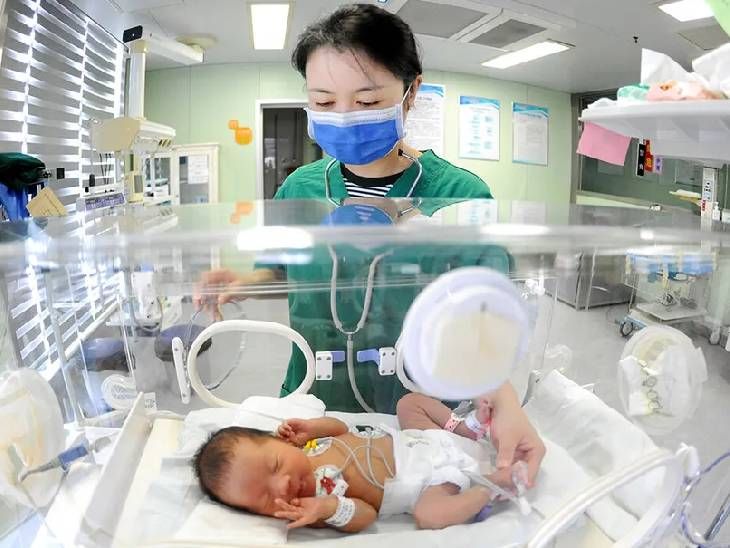
Chinese couples are marrying at older ages than older generations. This is one of the reasons for the increasing problem of infertility. Infertility among couples who can have children was found to be 18% in 2020, whereas in 2007 it was 12%. This has increased the demand for IVF. In China, the number of people undergoing treatment to give birth to a child with the help of a lab increased to 11 lakh in 2019 as compared to 2.36 lakh in 2013. Today there are 600 licensed clinics in China. According to available data, about three lakh children were born through IVF in 2022. In a country that is desperate for more children, this small number has also caught the attention of the government. The Chinese government has started giving a good package to increase the birth rate. In 2025, a scheme has been started to give an allowance of Rs 47689 every year per child below three years of age. In January, the VAT rate on condoms was increased to 13%. In 2022, the central government has included fertility treatment in public insurance schemes. In 2024, the cost of IVF treatment for more than one million people was reimbursed. All 31 provincial governments have included it in their plans for mid-2025. One cycle of IVF costs 20 to 50 thousand yuan. Many cities are offering up to ten thousand yuan. Still, population experts doubt that IVF subsidies will significantly increase the birth rate. Japan and South Korea have been spending heavily on policies to increase birth rates, including IVF, for decades. Neither population has seen much growth. To significantly increase the fertility rate in China, support programs will have to be multiplied. This is not so easy. More patients are coming to hospitals whose age is between 35-40. The success rate is low at this age. Stuart Geitel Basten of the Hong Kong University of Science and Technology says IVF helps with infertility, not confusion or uncertainty about having a child. Thus, very few people benefit. In China this pool is further shrunk by problems of limited access and government policies. The number of clinics is more in affluent cities. From 2023 to 2025, 53 thousand people in Beijing, with a population of 22 million, had undergone fertility treatment through government insurance. In comparison, less than 6,000 women in the north-eastern province of Jilin, with a similar population, benefited in the first year of the scheme’s launch in 2024. These disparities reflect the structure of China’s health system, says Karen Eggleston of Stanford University. Provinces have to bear the lion’s share of their insurance costs. That’s why affluent areas spend more. People in poor areas do not have the ability to get treatment. For example, Ningxia’s annual per capita income is less than one cycle of treatment. Additionally, there are strict national and provincial regulations for IVF. Only married couples can undergo the treatment. In many places the mother’s age is taken into consideration. The rules for freezing eggs are very strict. Fertility rate is very low. China is among the countries which have the lowest fertility rate in the world. The average Chinese woman has only one child in her lifetime. This is much lower than the 1.8 in 2017 and the 2.1 needed to keep the population stable.
Source link
China is taking the help of IVF to increase the population: Infertility is 18 percent, due to this the number of people undergoing IVF increased to 11 lakh.
 By ayoobkk2022