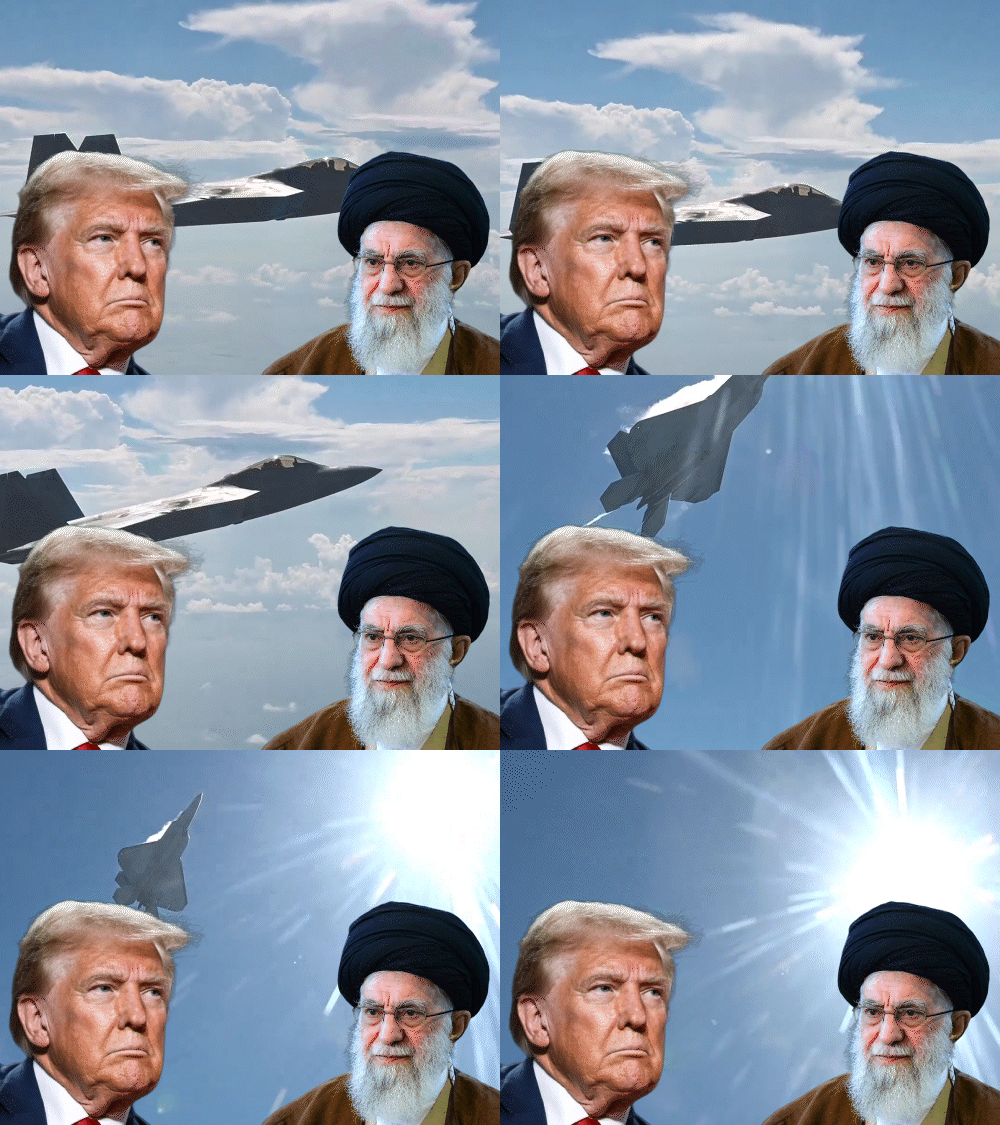
America has sent more than 50 fighter jets to the Middle East in the last 24 hours. Independent flight-tracking data and military aviation monitors have recorded several F-22, F-35 and F-16 fighter jets heading toward the Middle East. This information came to light during the second round of talks between America and Iran in Geneva on Tuesday. There are differences between the two countries regarding issues related to the nuclear deal. US Vice President JD Vance said that Iran is not ready to accept the conditions set by President Donald Trump. In an interview with Fox News, Vance said that some parts of the talks were positive, but there was still no agreement on many important issues. It is clear from these statements that the ongoing talks regarding Iran’s nuclear program are still in a delicate phase. Trump has already said that if Iran does not accept American demands, America will use force. America also sent refueling tankers to the Middle East. Along with American fighter jets, many aerial refueling tankers have also been seen going towards the Middle East. This indicates that the aircraft are in preparation for long-term operation. Meanwhile, US officials told the media that USS Gerald R. The Ford Aircraft Carrier Strike Group has arrived in the Mid-Atlantic from the Caribbean and is heading towards the Middle East. He is expected to reach in the next four-five days. According to news agency AP, the official, who spoke on condition of anonymity for security reasons, said that Ford is also accompanied by three guided-missile destroyers, USS Mahan, USS Bainbridge and USS Winston Churchill. USS Abraham Lincoln and other significant US air and naval assets have also been deployed to the region earlier this year. This has further strengthened America’s military presence in the Middle East. Know about F-35 and F-16 fighter jets… Iran begins naval exercises to test operational capabilities. Iran on Tuesday temporarily closed parts of the Strait of Hormuz, one of the world’s most important oil routes. The move was taken during a live-fire military exercise. Iran had announced this new exercise on Monday. It was named ‘Smart Control of the Strait of Hormuz’. According to Iranian news agencies, the missile tests were conducted in the narrow part of the Persian Gulf. Iranian media, citing security and maritime reasons, said the closure would last for a few hours. According to the Associated Press (AP), its purpose is to test intelligence and operational capabilities. Maritime security company EOS Risk Group said ships passing through the area had been warned over radio in advance. During a similar exercise held in late January, the US Central Command had issued a strong statement. He had said that Iran has the right to operate professionally in international air and maritime space, but should not harass American warships or trade vessels. The Strait of Hormuz, an important route for the world’s oil trade, is about 33 kilometers (21 miles) wide at its narrowest. It connects the Persian Gulf to the Gulf of Oman and further to global markets. About 20% of the world’s oil supply passes through this route. Oil and gas from Saudi Arabia, Kuwait, Iraq, Qatar, Bahrain, UAE and Iran go out from here. Most of the consignments are for Asia. According to the US Energy Information Administration, there is no practical alternative to this route, although Saudi Arabia and the UAE have built some pipelines that bypass this route. Although the strait is considered an international waterway and open to all ships, the territorial waters off its shores are controlled by Iran and Oman. Dispute over ballistic missile stuck between Iran and America: The ballistic missile project has become the biggest issue of controversy in the ongoing nuclear deal talks between Iran and America. Iran is not ready to compromise on this at all and considers it as its red line. Iran says this is necessary to protect its ballistic missile program. Iran says that when Israel and America attacked Iran’s nuclear sites in June 2025, only Iran’s missiles protected it. Along with this, America wants Iran to stop supporting proxy groups like Hezbollah and Houthi. America wants to include this issue as well, but Iran mainly wants to focus only on the nuclear issue. Iranian officials have repeatedly said there will be no talks on the missile program. This is Iran’s defensive capability and giving it up would mean weakening itself. Iran says talks will be limited to the nuclear program only, not missiles or regional groupings. Vance said – the final decision on the talks is in Trump’s hands. Vance said that the final decision on how long to continue the talks will be taken by President Trump. He said- We will continue our efforts. But the President has the authority to decide whether diplomacy has reached its limits. We hope that this time the talks will not reach a bad conclusion, but if it does, the decision will be taken by the President. According to US officials, Iran will make a bigger proposal in the next two weeks, so that differences between the two sides can be reduced. Iranian Foreign Minister said – If there is an attack, it will affect others too. On the other hand, Iran’s Foreign Minister Abbas Aragchi has expressed hope regarding the talks. He said that a new window has opened towards agreement. “We hope that the talks will lead to a durable and consensual solution that will be in the interests of all parties concerned and the entire region,” Aragchi told a UN conference after the talks. However, he also said that Iran is fully prepared to respond to any threat or attack. He warned that if Iran is attacked, it will not be the only country to suffer its consequences, but it will affect others as well. ———————– Read this news… Trump said – I will be indirectly involved in the talks with Iran: Last year’s bombing on nuclear sites made him wise. US President Donald Trump said on Monday that he will be indirectly involved in the talks on the nuclear program between America and Iran. He said this while talking to journalists in Air Force One. Read the full news…
Source link
America’s 50 fighter jets leave for Middle East: These include F-22, F-35 and F-16, America said – Iran is not accepting the conditions, we have other ways.
 By ayoobkk2022