
Lujiazui Business Districk in Pudong, Shanghai, China.
Liqun Liu | Construction Photography | Hulton Archive | Getty Images
Asian equity markets are attracting global investors, with a surge in initial public offerings, rising cross-border flows, and accelerating deal activity underscoring the region’s growing importance in global capital markets, according to senior executives at JPMorgan and Goldman Sachs.
“It’s unbelievable what activity we’re seeing [in Asia],” Sjoerd Leenart, JPMorgan’s Asia Pacific CEO, said on CNBC’s “Access Middle East” Monday, adding that a significant share of IPO volumes last year came from the region. IPO proceeds in Asia Pacific also more than doubled last year, according to EY data, with seven out of the top 10 global deals happening in the region.
“We see this [activity] in the M&A markets … but also in the equity markets, and it’s actually quite widespread,” Leenart said.
The strong inflows at the start of the year follow a robust 2025, when several Asian equity benchmarks outperformed the U.S.
The MSCI AC Asia Pacific index, which tracks over 1,000 large- and mid-cap stocks across 13 regional markets, has hit multiple records this year, having gained more than 25% in 2025. Japan’s benchmark Nikkei 225 and South Korea’s Kospi have also hit all-time highs in recent days.
According to data from Goldman Sachs, foreign inflows into South Korean markets have been healthy, with Korea-focused mutual funds seeing about $1.3 billion in net inflows this year as of mid-January.
Similarly, daily turnover across China’s Shanghai, Shenzhen and Beijing stock exchanges hit record this month, prompting regulators to tighten margin financing rules.

In 2025, Asia-Pacific was the largest region by IPO proceeds, according to a recent study by EY. The region saw a 106% surge in proceeds compared with 2024, with India remaining the world’s top active listing destination by deal count.
“China, Hong Kong have been a big part of that. And it’s fantastic to see the market confidence coming back,” said Leenart.
“That positive trend from 2025 I think, is likely to set through in 2026,” Leenart added. “The Chinese are doing everything to continue to stimulate the economy, and that’s what people are betting on.”
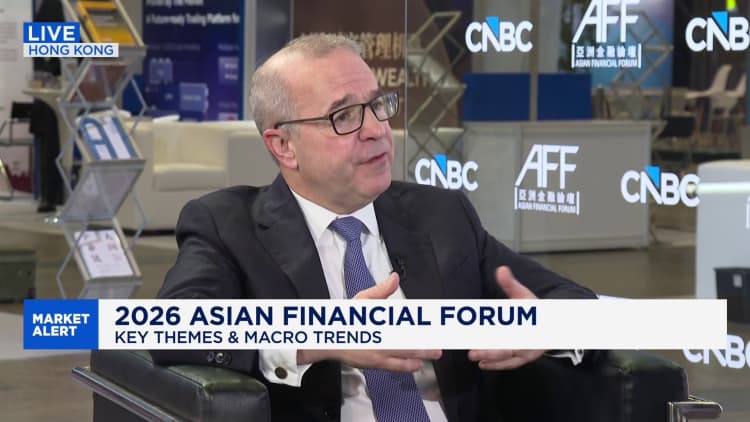
The renewed interest in Asia comes as investors reassess how businesses and markets are functioning amid persistent geopolitical uncertainty. Kevin Sneader, Goldman Sachs’ APAC ex-Japan president, told CNBC that markets have become more adept at operating through volatility rather than waiting for it to pass.
“China, India, Japan, Korea. Very much on the attention of international investors,” he said.
“It is true to say there’s a lot of renewed interest in Asia and renewed interest in China. Part of that has come from resilience and indeed, the impressive way in which technology has been developing in this part of the world,” Sneader said, highlighting South Korean markets and its semiconductor companies as a key beneficiary.
Technology firms Samsung Electronics and SK Hynix together account for over 30% of the entire Kospi index, data from Yuanta Securities showed. SK Hynix soared 274% in 2025, and has advanced 20% so far this year, as per LSEG data. Samsung Electronics skyrocketed 125% last year and has gone on to advance 30% year to date.
Goldman Sachs expects Chinese equities to rise about 20% this year. It has also lifted its 12-month target for Taiwan’s TAIEX to 34,600 from 32,400, implying 8% upside citing stronger-than-expected earnings growth as AI demand boosts the outlook and investment plans of the TSMC — the world’s largest chipmaker.
Goldman said rising capital spending at TSMC and sustained tightness in advanced chips are lifting profit forecasts across Taiwan’s broader semiconductor and hardware supply chain.
Late Monday, President Donald Trump said that he was increasing tariffs on imported autos, pharma, and lumber from South Korea from 15% to 25% because of a delay in that country’s legislature approving a trade deal with the United States reached last summer.
While some auto stocks fell, South Korea’s Kospi was trading 0.6%.
“Tariffs are a part of life. I think business leaders are learning to live with them and understand that,” Sneader said a day earlier. “In that context, what really matters is how their businesses perform, and for investors, how you factor that into your decision making.”
— CNBC’s Emily Tan contributed to this story.