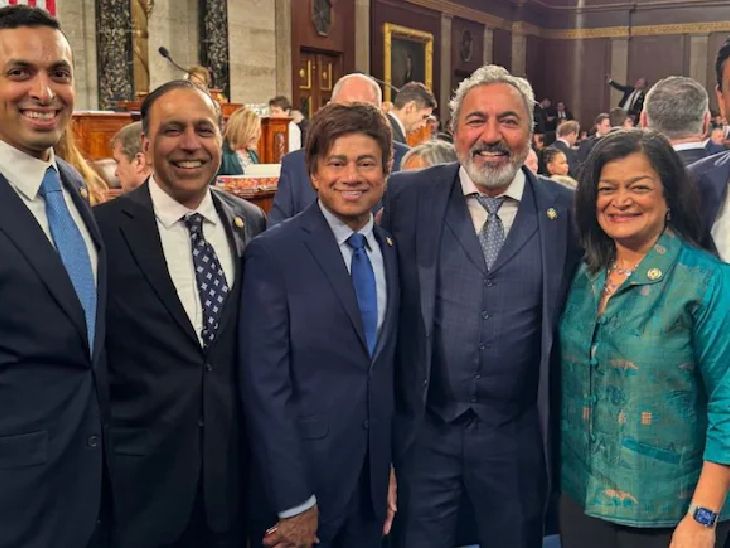
When it comes to money and knowledge, Indian-Americans are far ahead of their population, but when it comes to power and representation, they are not even in proportion to their population. This means that this community is playing a big role in building America, but its role in deciding the direction of America is still very small. Read the last part of the report ‘The story of the strength of Indians in America’ prepared by BCG and Indiaspora, how much weight do Indians have in power in America? The political journey of Indians in America has started from one MP in 1955 and has reached only 6 MPs. Meaning, the representation of Indians in the American Parliament is still very less. There is not a single Indian in the upper house, the Senate. After the 2024 elections, the number of Indians in the lower house will increase to 6. However, US President Donald Trump has appointed Kash Patel as FBI director. Dr Jai Bhattacharya has been appointed as the Director of the National Institutes of Health. Sriram Krishnan was given a key role in guiding AI policy for the government, which shows the growing presence of Indian people. Parliament; Only 6 out of 435 seats are of Indian origin – Out of the total 435 seats in the lower house of the US Parliament (House of Representatives), Indians are of only 6 seats (1.4%). – Before 2012, only two Indians had arrived. Dalip Singh Saund in 1955 and Bobby Jindal in 2004. After Ami Bera in 2012, this number has gradually increased to half a dozen. – At present there is not a single Indian in the Upper House i.e. Senate. There are 100 senators, 2 each from 50 states, the Senate’s approval is necessary for a bill passed from the lower house. Kamala Harris became the first Indian-American member of the Upper House in 2016. After becoming the Vice President in 2020, there is no Indian of Indian origin in the Upper House. In top government agencies… only 3% – Indians have a huge contribution in the field of healthcare and science, but only 3% Indians hold senior positions in America’s top government agencies like ‘Center for Disease Control’ (CDC) and ‘National Science Foundation’ (NSF). This means that the share of Indians in the work place is 10%, but in the decision making place it is only 3%. These institutions decide which research gets funded, which university gets grants, which technology gets invested in. – Due to less number of Indian-Americans in these positions, the needs of their community, their research topics and priorities are left behind. While these are big game changers in elections – Indians may constitute 1% of the total eligible voters in America, but they have a significant influence in the ‘swing states’ (states considered decisive in elections). These voters are now voting vocally on issues like immigration reform, civil rights and India-US bilateral relations. The report says that these voters are very important in deciding or changing the results in close contests. – Nikki Haley and Vivek Ramaswamy, both of Indian origin, were candidates in the 2024 Republican primary election. Kamala Harris was the Democratic presidential candidate. This shows the political importance of this community. Indian-origin professionals who have left their mark in IMF, WHO and World Bank are playing important leadership roles in global institutions. Geeta Gopinath at IMF gives direction to economic revival and vaccination strategies in Covid. Raghuram Rajan, former chief economist of the IMF, influenced global financial policy by pre-warning the 2008 financial crisis. Indermeet Gill and Mamata Murthy at the World Bank strengthened development policies with new ideas. From 2023, President Ajay Banga is focusing on climate projects and poverty alleviation. Soumya Swaminathan strengthened global cooperation in health sector at WHO.
Source link
BCG Report: Final, how much power do Indians have in the US?: Far from power, 1% in the lower house of America, no Indians in the Senate
 By ayoobkk2022