
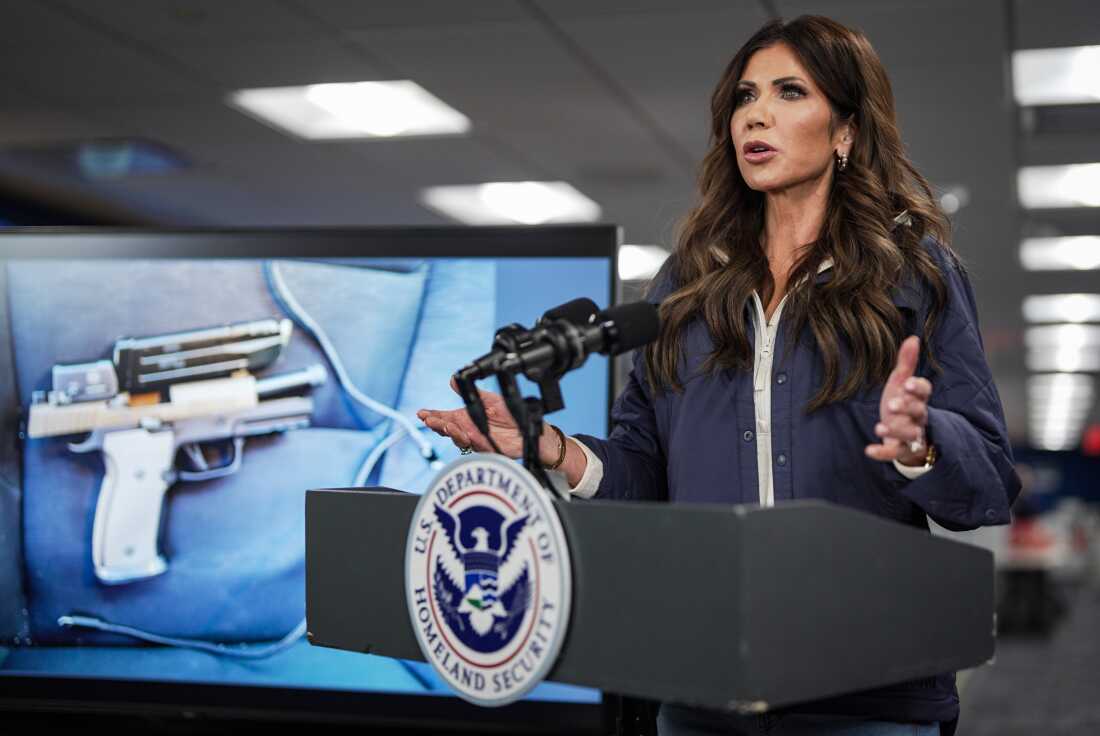

A photograph of the pistol recovered by immigration agents after a shooting in Minneapolis is shown on a screen behind U.S. Secretary of Homeland Security Kristi Noem as she speaks during a news conference in Washington, D.C., on Jan. 24. Federal immigration agents shot and killed Alex Pretti that day during operations in Minneapolis.
Al Drago/Getty Images
hide caption
toggle caption
Al Drago/Getty Images
On a Saturday in early October, Marimar Martinez, a 30-year-old teacher and American citizen, was driving her car when she noticed federal immigration agents in her Chicago neighborhood. She began following them, as did the driver of another car. She honked her horn and shouted “la migra” to warn her neighbors that immigration agents were nearby.
As she drove alongside a Chevy Tahoe driven by Border Patrol agents, the vehicles made contact — who swerved into whom is a point of dispute. Martinez then began to drive away. A Border Patrol agent fired at her five times.

The Department of Homeland Security quickly alleged Martinez had “rammed” the Border Patrol vehicle. “This woman — who, by the way, is a Montessori school teacher with no criminal history — she’s now, all of a sudden, a ‘domestic terrorist,'” her attorney, Chris Parente, told NPR. “This is before there’s any investigation done.”

Marimar Martinez (center) is greeted by her family after being released from the Metropolitan Correctional Center in Chicago on Oct. 6, 2025, after being shot by a Border Patrol agent. She was initially charged with assaulting federal officers but federal prosecutors later dropped all charges against her.
E. Jason Wambsgans/Chicago Tribune/ZUMA Press Wire via Reuters
hide caption
toggle caption
E. Jason Wambsgans/Chicago Tribune/ZUMA Press Wire via Reuters
Federal prosecutors dropped all charges against Martinez, who survived the shooting. But a Department of Homeland Security press release with her name, mug shot and the accusation that she is a “domestic terrorist” is still online, as are a number of posts on X by high level Trump administration officials that paint her as a criminal who attacked law enforcement. One post with allegations about her was reshared by FBI Director Kash Patel and inaccurately links to video footage from a different incident she had nothing to do with.
The @FBI just arrested two individuals who were allegedly driving these vehicles and attacking our federal law enforcement officers.
They have been charged for assaulting federal officers with a deadly or dangerous weapon.
Attack our law enforcement, and this FBI will find you… https://t.co/iQ9wDeAzQh
— FBI Director Kash Patel (@FBIDirectorKash) October 6, 2025
In recent weeks, the Trump administration swiftly attempted to justify the shootings of Renee Macklin Good and Alex Pretti by claiming they were carrying out acts of domestic terrorism in the moments before they were killed. They made these claims without waiting for investigations to unfold, and in spite of conflicting video evidence and witness accounts. As Martinez’s case and others demonstrate, these statements are part of a much broader, months-long communication pattern by the administration on immigration related issues.
Trump administration officials have repeatedly made unproven or incorrect claims when describing immigrants targeted for deportation, U.S. citizens arrested while protesting the administration’s immigration crackdown and people who simply drove through areas where an immigration enforcement operation was going on.
On social media, the administration has accused people of violently attacking federal immigration agents or impeding operations. In many instances, criminal charges were quietly dropped or never filed.

While it’s not uncommon for law enforcement agencies to make allegations about suspects that wind up being disproven, many of DHS’s accusations against private individuals stand out for their hyperbolic language.
“It seems to me that they are not writing these statements with the intention of ever supporting them in court, but just to try and convince officers and their voter base,” said Greg Jackson, an attorney in Southern California who has clients who were shot at by federal immigration agents.
Trump administration officials and their allies online frequently celebrate deporting the so-called “worst of the worst.” They used such language when referring to the alleged “terrorists” the administration sent to El Salvador’s brutal CECOT prison last spring. But nearly half of the Venezuelan men sent to CECOT had no criminal history, according to an analysis by Human Rights Watch, and only eight men out of 252 had convictions for violent or potentially violent offenses.
The administration’s mischaracterizations have also spilled over to courtrooms, where federal judges in dozens of cases have admonished federal officials for providing false, contradictory or unreliable statements in court.
“There are armed masked men in the streets acting as paramilitary agents of the state being directed to grab people up on behalf of false claims, and the government is lying about what happens before, during and afterward,” said Brendan Nyhan, a professor at Dartmouth College who studies political misinformation and misperceptions.
“Every American should be worried about that, because if they can lie about this, what else could they lie about? And if it’s your family member who gets killed, what recourse do you have?”

Masked ICE agents leave a residence after knocking on the door in Minneapolis on Wednesday.
Stephen Maturen/Getty Images
hide caption
toggle caption
Stephen Maturen/Getty Images
In response to NPR’s questions, an unnamed DHS spokesperson said in a statement, “DHS law enforcement is prioritizing the arrest and removal of dangerous public safety threats. Under President Trump’s and Secretary Noem’s leadership, DHS has always been steadfast in targeting dangerous criminal illegal aliens, including murderers, rapists, pedophiles, drug traffickers, gang members, and terrorists.”
A familiar pattern
In the wake of Border Patrol agents shooting 37-year-old Alex Pretti, an ICU nurse, in the street on Jan. 24, Trump’s deputy chief of staff Stephen Miller called Pretti a “would-be assassin” in a post on X.
In separate press conferences the day of the shooting, both Border Patrol Commander Greg Bovino and Homeland Security Secretary Kristi Noem said it appeared Pretti intended to do “maximum damage” and kill law enforcement. Noem referred to him “brandishing” a weapon, but video evidence showed he had a handgun but never took it out of its holster.

The response also echoed the immediate aftermath of Renee Macklin Good’s killing, when officials accused her of trying to run over and murder an ICE agent before he fatally shot her.
On Thursday night, Fox News host Sean Hannity asked Noem to address the pushback she received over her messaging around the shootings. “People seem to be upset over the term domestic terrorism. Why do you believe that’s appropriate?”

Border Patrol Commander Greg Bovino speaks during a news conference in Minneapolis on Sunday. The news conference comes after 37-year-old Alex Pretti was fatally shot by federal agents.
Brandon Bell/Getty Images
hide caption
toggle caption
Brandon Bell/Getty Images
Noem answered, “We’re continuing to gather information,” rather than defend the term.
A bystander video of Pretti has surfaced in recent days that shows a separate incident that occurred 11 days before he was killed by federal agents. The video shows Pretti spitting at an SUV full of agents then kicking the vehicle, breaking a rear tail light lens. A number of agents jumped out and wrestled him to the ground.
“Agitator and, perhaps, insurrectionist, Alex Pretti’s stock has gone way down,” Trump wrote on Truth Social early Friday.
Jackson, the attorney in Southern California, said the government’s initial messaging about the Minnesota shootings sounded familiar to him, because of similarities with statements about the two men he represents who were both shot at by federal agents in their cars in two separate incidents over the summer.
He said, as in his clients’ cases, the government’s narrative around the Good and Pretti cases sought to “make it as if their agents are the victims and the people who were actually shot or shot at are the offenders.”
He said both his clients have suffered reputational harm by DHS statements and the allegations against them.
“They were branded as these violent criminals,” Jackson said. “And neither of them has any criminal history whatsoever.”
DHS has accused one of Jackson’s clients, Francisco Longoria, of attempting to “run over” U.S. Customs and Border Protection officers and injuring them with his pickup truck after they surrounded the truck and smashed his windows. Surveillance video from across the street shows Longoria’s pickup driving away and armed officers returning to their vehicles. There is no obvious sign any of the officers were injured.

Ultimately, criminal charges against Longoria were dropped and Jackson is helping him sue to recover damages. Jackson’s message to the public is to keep a distance and don’t physically engage with officers — but record everything.
Chris Parente, who represents Martinez in Chicago, was in court Thursday asking the judge to unseal evidence, including bodycam footage, that shows what happened the day Martinez was shot.
Text messages written by Border Patrol agent Charles Exum were turned over in the case and have already been made public.
“I fired 5 rounds and she had 7 holes. Put that in your book boys,” Exum wrote in a Signal chat, after sharing a Guardian article that quoted Parente describing Martinez’s injuries. In another text thread he wrote, “Sweet. My 15 mins of fame. Lmao.”
When her case was initially dismissed, Martinez agreed for some of the evidence to remain sealed. But in the aftermath of the Good and Pretti shootings, Martinez wants the public and elected officials to see that material to understand how DHS responds to the shootings, Parente said.
And given that she continues to be accused in a government press release and X posts of being a “domestic terrorist,” Parente wrote in his motion that disclosing the evidence “is paramount to Ms. Martinez’s ability to combat the continuing harm being done to her reputation.”
NPR asked DHS if the agency plans to take down or update their online statements given that charges against Martinez have been dropped. Instead, in a statement to NPR on Friday, DHS reiterated that accusation again.
“Border Patrol law enforcement officers were ambushed by domestic terrorists that rammed federal agents with their vehicles. The woman, Marimar Martinez, driving one of the vehicles, was armed with a semi-automatic weapon and has a history of doxing federal agents,” the statement reads.
In court testimony, Exum acknowledged that Martinez had not “rammed” him. Martinez has denied doxing federal agents, Parente said, and says the allegation is “based entirely” on Martinez resharing a Facebook post highlighting an ICE agent’s public website for his DJ business. He said evidence photos in the court record show her handgun, for which she has a concealed carry license, was holstered at the bottom of her purse.
At Thursday’s hearing about unsealing the evidence, after federal prosecutors indicated concerns, Judge Georgia Alexakis acknowledged such a move would be unusual.
“I also think that we’re finding ourselves in an unusual situation in which the government made exceedingly public statements about a criminal defendant, who under our American system of justice is presumed innocent, and have made no efforts to equally publicize the fact that they abandoned the opportunity to convict her, to try to convict her in a court of law, even though that’s completely within their power to do that,” Alexakis said.
No charges, just accusations
DHS officials have continued to accuse George Retes, a U.S. citizen who was detained by federal immigration officers in July, of assaulting an officer even though no criminal charges against him have ever been filed.

Federal agents block a field and road during an ICE immigration raid at a nearby licensed cannabis farm near Camarillo, Calif., on July 10, 2025.
Mario Tama/Getty Images
hide caption
toggle caption
Mario Tama/Getty Images
Retes was on his way to his job doing security at a cannabis farm in Southern California where protesters had gathered to demonstrate against federal immigration officers conducting a raid. An agent pepper sprayed him, smashed his window and dragged him out of the car, according to his account. He was held in detention for three days but was never criminally charged.
After he wrote about his experience for The San Francisco Chronicle in September, the DHS account on X wrote that Retes was not wrongfully arrested and said he “became violent and refused to comply with law enforcement. He challenged agents and blocked their route by refusing to move his vehicle out of the road. CBP arrested Retes for assault.”
The same post continued, “These types of smears are designed to demonize and villainize our brave ICE law enforcement. This kind of garbage has led to a more than 1000% increase in the assaults on enforcement officers.”
As CBP and ICE agents were executing criminal search warrants on July 10 at the marijuana sites in Camarillo, CA, George Retes—a U.S. citizen—became violent and refused to comply with law enforcement. He challenged agents and blocked their route by refusing to move his vehicle… pic.twitter.com/aKS2voKU3j
— Homeland Security (@DHSgov) September 17, 2025
“It’s a complete lie. The proof is all there,” Retes said in an interview with All Things Considered in October. “There’s helicopter footage. They never charged me. Even though they sent out a tweet telling everyone that I assaulted agents and they paint me as a criminal, they never pursued charges.”
He said it felt like the government was trying to intimidate him from speaking out. “Unfortunately for them, it’s not going to work … people deserve the truth and deserve to know whether or not the government is lying or not.”
After he wrote another piece in the Houston Chronicle in December, DHS posted on X repeating the accusation that he assaulted a law enforcement officer. In its statement to NPR, DHS again repeated the claim about Retes, who is preparing a civil lawsuit against the federal government to recover damages for his rights being violated.
Such lawsuits are difficult to win, because unlike state or local officials, federal officials are protected by immunity in many cases. That fact is likely giving federal officials the confidence that they can make false accusations about people without being held accountable, said Anya Bidwell, a lawyer at the nonprofit Institute for Justice who is representing Retes in his pending suit.
“And because they fully understand it, they have no problem going out there, being extremely aggressive, misrepresenting the facts, misrepresenting the record,” Bidwell said. “Fundamentally, they know that it’s not going to be that often where they actually would have to show up in court and defend their statements.”
Targets of deportation
The Trump administration has promoted its aggressive immigration enforcement tactics as necessary to rid the country of dangerous criminals. The administration has quadrupled deportations in the country’s interior in part by massively increasing removals of immigrants without criminal records, a recent study by the Deportation Data Project found.
An NPR review of the DHS and ICE X accounts shows that in the first year of this administration, the two agencies posted about more than 2,000 foreign-born individuals targeted for immigration enforcement, an average of five posts a day. The posts contain similar elements: a photo, name, age, nationality and usually criminal charges. In over 1,300 cases, the people are described as some combination of “criminal” “illegal” and “alien”. (The agencies also post about targets of law enforcement not related to immigration, but such posts do not typically include photos of the suspects.)
“People are being told to fear violent criminals in their midst,” said Nyhan of Dartmouth College. “They’re being shown seemingly scary pictures of criminals from vulnerable outgroups and told that they’re being kept safe by dragging those people away. And that messaging is being used to obscure the fact that the majority of the people being grabbed have no record of violent conduct at all.”
The Trump administration has, on multiple occasions, misrepresented the gang affiliations of people they’ve arrested. Last fall, ICE raided a building in Chicago, saying it was a gathering place for the Venezuelan gang, Tren de Aragua. Out of the 37 people arrested, only two were gang members. The other 35 had entered the country illegally.
The administration’s exaggerated claims “are justifying extreme emergency level powers on the part of the executive branch — both in extremely draconian uses of immigration enforcement that we’re seeing … and in the use of the military domestically,” said Ryan Goodman, a law professor at New York University School of Law and co-editor-in-chief of the online journal, Just Security.
During the 2024 campaign, Trump and Vance amplified the false claim that Haitian immigrants in Ohio were eating pets. Candidate Trump repeatedly mentioned the baseless claim that Venezuela was opening its prisons and mental institutions and sending those people to the U.S., and has continued to repeat this as president.

Demonstrators try to stop a car leaving an ICE processing center during a protest in Broadview, Ill., on Sept. 19, 2025.
Octavio Jones/AFP via Getty Images
hide caption
toggle caption
Octavio Jones/AFP via Getty Images
Most recently, the Trump administration has lashed out at Somalis in Minnesota. Officials have helped amplify unverified claims about fraud perpetuated by the Somali community, which was used in part as a justification to crack down on the state.
Ahilan Arulanantham, a professor at UCLA School of Law, said he believes the prevalence of what he called “macro lies” from the White House has “translated down into the behavior of lower level government officials.”

In November, a federal judge in Chicago accused Bovino of “outright lying” in his court testimony. The judge wrote, “Bovino admitted in his deposition that he lied multiple times” about the events leading up to his decision to pepper spray protesters during DHS operations in the city last year.
That finding is just one of more than 60 instances of judges calling out the second Trump administration officials for providing false information through November, according to a tally by Just Security.
“If they can do it in one case, what stops them from doing it to anyone, really?”
The Trump administration has publicized inaccurate information about some of the immigrants it is trying to deport.
Ramón Morales Reyes, a Mexican immigrant in Wisconsin living in the country without legal status, was the victim of a burglary and an assault in 2023. Last May, he also became the victim of official misinformation when DHS and the White House publicly accused him of a crime he didn’t commit.
His assailant, Demetric Scott, later admitted that he framed Morales by forging a letter making threats to assassinate Trump in Morales’ name. The letter was part of an elaborate plan to get Morales Reyes deported so he would be unable to testify against Scott.
Morales Reyes was arrested by ICE and detained, though investigators quickly realized that he had not written the letter and turned their attention to Scott. This week, Scott was convicted of witness intimidation by a jury.
Despite that, Noem issued a statement with Morales Reyes’ name and photo, thanking ICE for putting an “illegal alien who threatened to assassinate President Trump” behind bars. The White House posted an image of his face on X captioned, “FAFO: Threaten to Kill the President as an Illegal Alien—You’ll Be Captured, Deported, and Never Set Foot on American Soil Again.” (FAFO stands for “f*** around, find out.”)
While in detention, Morales Reyes experienced harassment due to the allegations and was stressed that he was being accused of a crime he didn’t commit, his lawyer Cain Oulahan told NPR.

Ramon Morales Reyes’ attorney, Cain Oulahan, (center) addresses the media in Milwaukee about the detention of Ramon Morales Reyes on May 30, 2025.
Andy Manis/AP
hide caption
toggle caption
Andy Manis/AP
Morales will not be charged for the threats but he is in deportation proceedings. After eight months, the federal government still hasn’t properly cleared his name, Oulahan said.
A small disclaimer now appears on Noem’s online statement about Morales Reyes. At the very bottom it notes he “is no longer under investigation for threats against the President.” But the disclaimer calls him a “criminal alien” and says he has “previous arrests” and lists charges.
Oulahan has yet to find records corroborating those arrests related to his client. He thinks the list of arrests likely refer to database results for someone else with the same name.
He’s appalled to see up close how the administration could publicize a smear.
“If they can do it in one case, what stops them from doing it to anyone, really? Anyone that disagrees with their policies, anyone who they see as an obstacle or someone that they want to get retribution against,” Oulahan said. “It’s very disturbing.”