
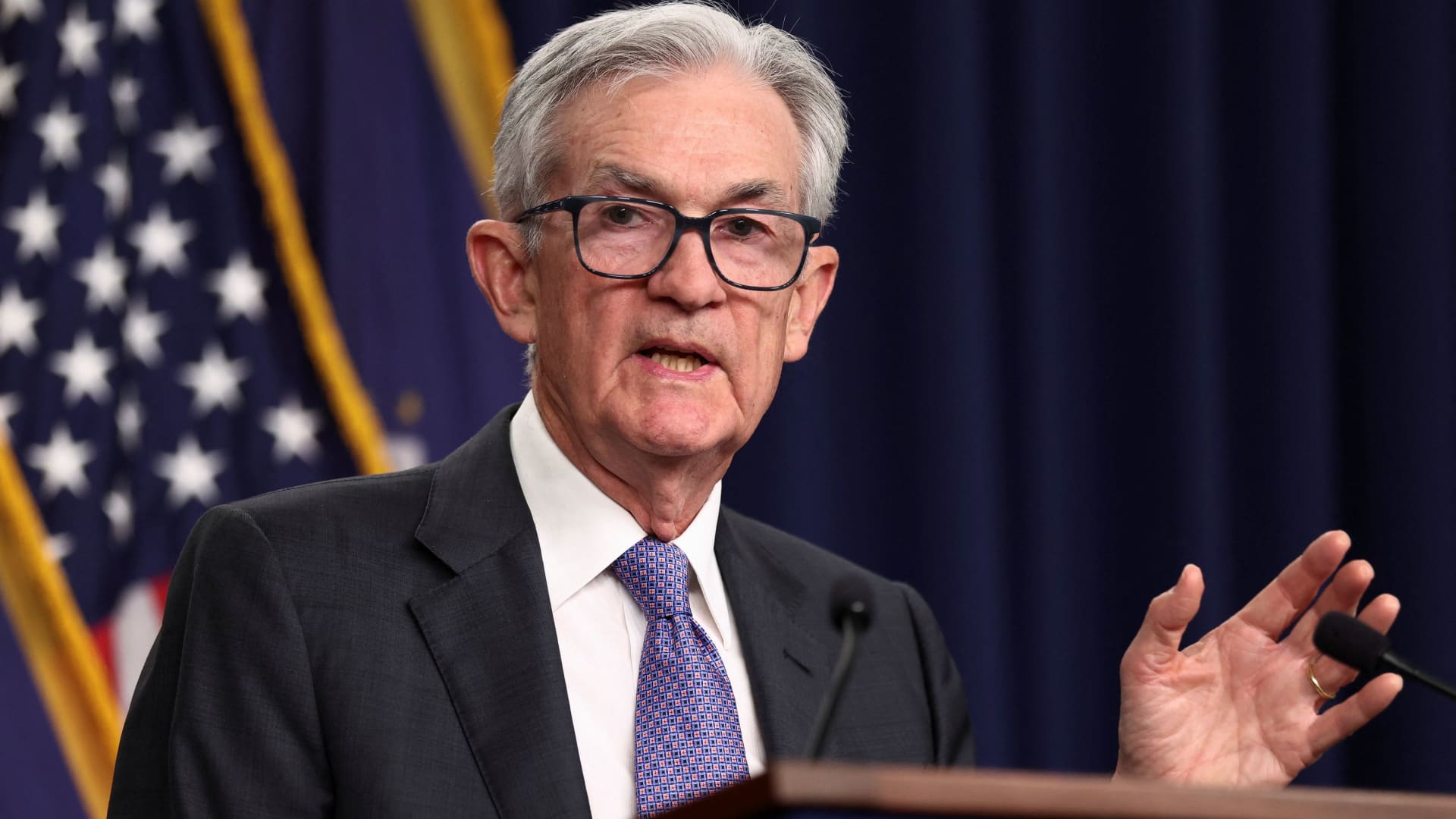
U.S. Federal Reserve Chair Jerome Powell speaks as he holds a press conference following a two-day meeting of the Federal Open Market Committee (FOMC), at the U.S. Federal Reserve in Washington, D.C., U.S., Dec. 10, 2025.
Kevin Lamarque | Reuters
Despite the expected arrival of a new Trump-appointed Federal Reserve chair in coming months, respondents to the CNBC survey are only forecasting modest changes to the funds rate over the next two years.
The results, which mirror pricing in Fed Funds futures market, show that neither Wall Street nor economic forecasters believe that the next Fed chair will drive down overnight rates towards the low levels demanded by the president.
The survey shows the average outlook is for two more quarter-point cuts this year, or 50 basis points, with no cuts expected yet for 2027. The Funds rate is seen settling around 3% this year and staying there through 2027. President Trump, who is currently considering who to name to replace Fed Chair Jerome Powell, has said U.S. rates should be among the lowest in the world and asked for the Fed to reduce interest rates to 1%.
Given a 2% inflation rate, the president is essentially asking for negative real rates.
A reason for the firmer rate outlook could be an improving growth view. GDP is forecast this year to come in at 2.4%, and 2.2% next year, both higher than what the Fed has typically viewed as potential growth of the economy. The unemployment rate is seen rising just a tenth from the current level to 4.5% by year end and dropping slightly next year.
“We anticipate continued solid and more consistent economic growth in 2026, underpinned by fiscal stimulus and easier monetary policy,” Kathy Bostjancic, chief US economist with Nationwide wrote in.
The Consumer Price Index is forecast to end the year at 2.7% and decline to 2.5% in 2027. The CPI can run around a half point higher than the Fed’s preferred PCE inflation gauge, so the forecast suggests the Fed comes close to its target by the end of this year and hits it by 2027.
Also working against rate cuts is a decline in the recession probability over the next year to 23% from 30% in the December survey. It rose as high as 53% in May, following the Liberation Day tariffs, which the president mostly reduced.
Tariff impact behind us?
Tariffs remain a significant source of concern, but 58% say the majority of the tariff effects are behind the economy. Still, large majorities say they will continue to drag down growth, unemployment and retail margins while pushing up inflation. The average respondent sees tariffs raising inflation by about 0.3% this year.
From the positive side, the economy is seen gaining momentum from capital spending and a strong consumer. More than two-thirds believe business investment will be stronger in 2026 than in 2025, likely the result of huge spending on artificial intelligence but also tax changes stimulating investment.
Nearly three quarters believe consumer spending will be higher or the same as in 2025, which is good news because last year was a strong year.
Productivity, already elevated even before the impact of artificial intelligence is widespread in the economy, is another potential plus, says Allen Sinai of Decision Economics. “A sustained and sustainable ‘productivity boom’ of historical proportions is driving a surprisingly strong and solid expansion with no inflation acceleration, a weaker but not weak labor market, and stunningly strong company earnings and profit margins,” he said, calling it “a 1990s-like picture.”
Still, there are risks, with the top concern among respondents “uncertainty around the Trump administration’s actions and policies,” followed by the bursting of the AI bubble, threats to the Fed’s independence, high inflation and tariffs.
With the survey coming in the wake of President Trump’s tariff threats over Greenland, several respondents also wrote in “geopolitical risk” as a major area of concern.
“Policy uncertainty acts as a tax on the economy,” says Diane Swonk, chief economist at KPMG. “It causes paralysis. I was hopeful policy uncertainty would abate as we move into 2026. Thus far, that has not been the case.”
But Douglas Gordon of Russell Investments sees the good outweighing the bad in 2026 for the economy. “There are certainly no shortages of potential exogenous risk sources to capital markets,” he wrote. “This comes, however, against a backdrop of seemingly waning tariff impact (save new ones), ‘good enough’ labor data, elevated but not worrisome inflation, and, perhaps most importantly, still robust earnings.”
Warsh over Rieder
The survey found some differences over who will be the next Fed chair between respondents and prediction markets. While Blackrock’s Rick Rieder leads in the prediction markets, 50% of respondents expect former Fed Governor Kevin Warsh to be tapped for the job by President Trump.
The prospect that Warsh will be named, compared to National Economic Council director Kevin Hassett in the prior survey, leads forecasters to feel more optimistic that the next Fed chair will run policy independently of the White House, even while he’s seen as more dovish than Fed Chair Powell.
While respondents think the president will pick Warsh, 44% think he should pick Fed Governor Chris Waller. They are evenly divided on whether Fed Chair Powell will remain on the board as a governor after his term expires at 42%, but a majority is concerned about the Fed’s independence if Trump appointees make up a majority of the Fed’s Board of Governors.
Yet respondents believe that the FOMC will oppose policy from a chair that is either too dovish or hawkish.