

NEWYou can now listen to Fox News articles!
Blue states appear to be on the brink of a growth decline, as a census analysis released Tuesday found that Democratic strongholds are likely to lose congressional seats to their Republican counterparts after 2030.
New York and California specifically are projected to lose a combined six seats, while Texas and Florida may gain eight, according to the 2025-based estimates forecast by Dr. Jonathan Cervas at Carnegie Mellon University and shared by Redistricting Network.
The new data most notably underscores a looming downfall for the Empire State, which has been steadily losing seats since the 1940s.
“This is not good news for New York or California,” said Jeff Wice, Director of the New York Elections, Census, and Redistricting Institute at New York Law School, according to the New York Post.
REDISTRICTING BATTLES BREWING ACROSS THE COUNTRY AS PARTIES COMPETE FOR POWER AHEAD OF 2026 MIDTERMS

People stand in Central Park in front of buildings on Oct. 29, 2023, in New York City. (Getty Images)
Other blue-state delegations, including Illinois, Rhode Island and Oregon, are also projected to lose one to two seats, while red states such as Utah and Idaho are expected to make small gains, the analysis shows.
If the 2030 apportionment predictions come true, the redistribution of Electoral College votes may make Democrats’ path more challenging.
DOJ URGES SUPREME COURT TO BLOCK CALIFORNIA MAP, CALLS NEWSOM-BACKED PLAN A RACIAL GERRYMANDER

Speaker of the House Mike Johnson, R-La., addresses the House chamber of the the U.S. Capitol on Wednesday, October 25, 2023. (Tom Williams)
According to the analysis, New York’s congressional delegation is projected to drop to 24 seats, continuing its steady decline from 45 seats in the 1940s. California, which currently has the largest delegation of any state, could fall to 48 seats.
Meanwhile, Texas is expected to surge from 38 to 42 House seats, and Florida from 28 to 32, in a post-census redistribution. Since 2020, Texas gained roughly 2.5 million residents and Florida 2 million, ranking the two states as some of the fastest-growing in the country by numeric population.
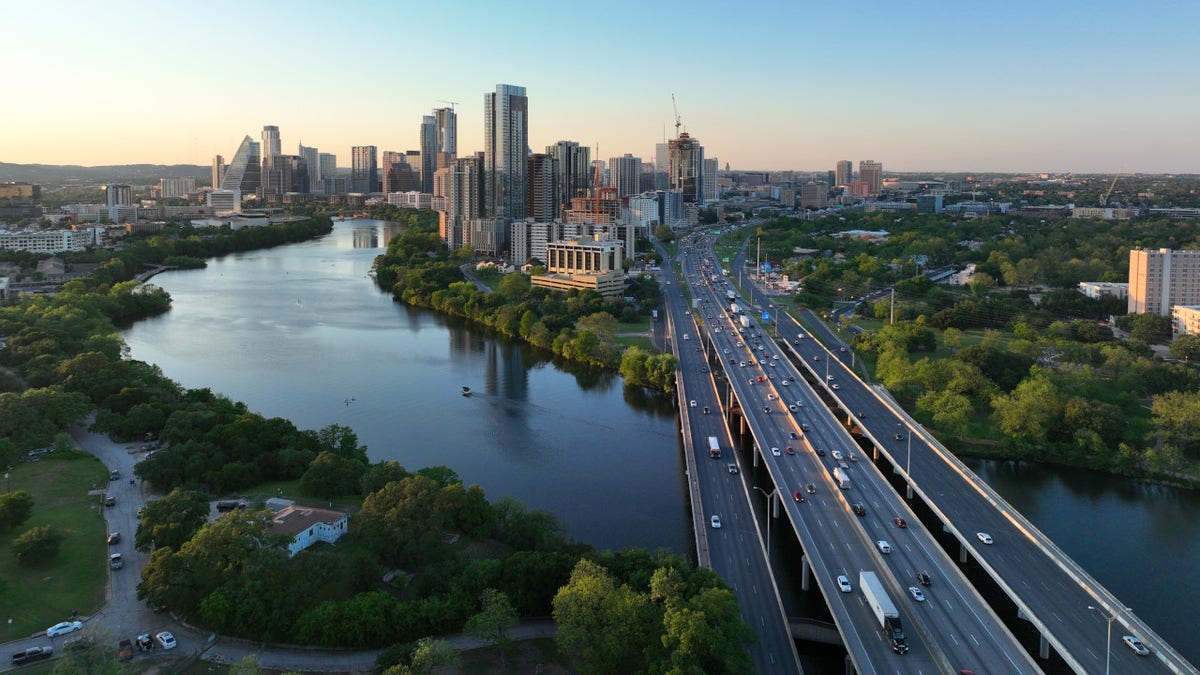
In an aerial view, the downtown skyline is seen on April 11, 2023, in Austin, Texas. The city of Austin has been ranked as the top destination of U.S. job markets following 2020. (Photo by Brandon Bell/Getty Images) (Brandon Bell/Getty Images)
CLICK HERE TO DOWNLOAD THE FOX NEWS APP
Wice added that blue states could face further seat losses if President Donald Trump and the GOP are able to require citizenship questions in the census. While the U.S. Constitution requires all residents to be counted regardless of status, questions about legal status could discourage illegal immigrants from responding and affecting the population count.