

Police in Maine said all six people on a private business jet are presumed dead after the plane crashed in a snowstorm at Bangor International Airport.
The Bombardier Challenger 600 crashed around 7:45 p.m. The FAA and National Transportation Safety Board are investigating.
A preliminary report posted online by the FAA had said there were seven fatalities after the plane “came to rest inverted and caught fire.” The FAA also previously said one crew member survived with serious injuries. However, the police later said that, according to the manifest, there were six people on the flight and they were all presumed to be deceased. The FAA deferred to local law enforcement and the NTSB.
Records show that the plane was registered to a law firm based in Houston, Texas, CBS affiliate KHOU reported.
The crash occurred as New England and much of the country grappled with a massive winter storm. Bangor had undergone steady snowfall Sunday along with many other parts of the country.
There was no initial word on the plane’s destination.
WABI via AP 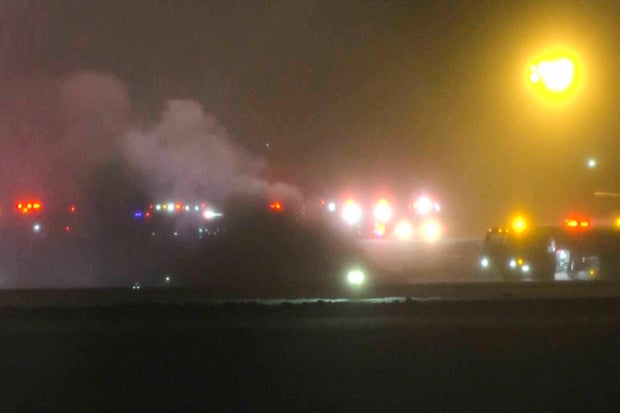
The airport issued a statement that emergency crews were on the scene at the airport, which was closed after what it described as an incident involving a single aircraft departing the airport. It remained closed Monday morning, the Bangor Police Department said.
The airport urged people to avoid the area and said the crash led to the cancellation of other flights.
According to LiveATC.net, which broadcasts air traffic controllers’ conversations, there was talk among the tower and planes minutes before the crash about visibility, though it wasn’t clear which planes were involved.
Then, one controller was heard saying there was “a passenger aircraft upside down.”
The NTSB said it has no role in the release of information about victims and that such information is handled by local authorities. But airport director Jose Saavedra refused to comment, saying at a news conference Monday that he was “awaiting guidance and support from federal partners.”
Bangor International Airport, some 200 miles north of Boston, offers direct flights to cities like Orlando, Florida, Washington, D.C., and Charlotte, North Carolina.
The National Weather Service in Caribou, Maine, said the airport received nearly 10 inches of snow in total, though the snowfall was just beginning at the time of the crash.
“We have crews on site that respond to weather storms on a regular basis,” Saavedra said. “This is normal for us to respond to weather events.”
Throughout the weekend, the vast storm dumped sleet, freezing rain and snow across much of the eastern half of the U.S., halting much air and road traffic and knocking out power to hundreds of thousands of homes and businesses in the Southeast.
Commercial air traffic was also heavily disrupted around much of the U.S.
More than 11,000 flights were canceled Sunday and nearly 5,500 were delayed, according to the flight tracker flightaware.com. Airports in Philadelphia, Washington, Baltimore, North Carolina, New York and New Jersey were among those impacted.
The Bombardier Challenger 600 is a wide-bodied business jet configured for 9 to 11 passengers. It was launched in 1980 as the first private jet with a “walk-about cabin” and remains a popular charter option, according to aircharterservice.com.
The airport in Bangor is by far the largest city in Maine’s northern and eastern reaches. Its longstanding joint use agreement with the Maine Air National Guard means “runways are ready rain or shine – or snow,” an airport website says, under the phrase: “A Little Snow Doesn’t Scare Us.”
Jet has history of problems with ice, safety consultant says
This particular plane model “has a history of problems with icing on takeoff” that has caused previous crashes, aviation safety consultant Jeff Guzzetti said. The former federal crash investigator said even a little bit of ice on the wings can cause serious problems, so this plane would have needed to be deiced before takeoff but it’s not clear when or if that.
The plane had just landed at Bangor from Houston at 6:09 p.m., according to FlightRadar24.com, so it would have likely been sitting outside in the snow for more than an hour before it tried to takeoff again. And it wouldn’t have taken long for ice to start building up on the wings — particularly if the plane was refueled with cold jet fuel that’s stored in wing tanks, a factor the NTSB has cited in previous crashes.
Airport officials said planes were being deiced at the airport at the time of the crash, but it wasn’t immediately clear whether this particular plane was treated before it tried to take off.
“Given the weather conditions at the time, and the history of wind contamination with this particular aircraft, I’m sure that’s something the NTSB is going to look into immediately,” Guzzetti said. “If there was any kind of precipitation at all, freezing precipitation, they would have needed to clean off those wings before they took off,” he said