

Gangster Lawrence Bishnoi and gangsters firing in Canada.
The Lawrence Gang syndicate, which is behind the ongoing extortion and violent incidents in Canada, has sent a letter directly challenging the British Columbia Police. In the letter, the gang has claimed that they have more than 1000 ‘foot soldiers’ or ground troops in Canada.
.
After the letter came out, there is an atmosphere of panic among the security apparatus of Canada and the South Asian community living there, especially the businessmen of Indian and Punjabi origin. This was revealed on Thursday during an ongoing deportation hearing in Canada.
According to Canadian media reports, a lead investigator of extortion cases and a detective of the Edmonton Police Service, while testifying before the Immigration and Refugee Board, said that the letter arrived at the Abbotsford Police Station in British Columbia on August 13, 2025 last year.
Investigation of the contents and sources of the letter
The letter exposes an organized crime network in Canada that is linked to Lawrence Bishnoi, who is jailed in India. Canadian police are now thoroughly investigating the contents of this letter and its sources.
Gangster Lawrence Bishnoi
Know sequentially what was said in Lawrence’s letter…
- Claim of army of 1,000 shooters: According to Canadian media, the biggest and scariest claim made in the letter is that the Bishnoi gang has completely spread its foothold in various provinces of Canada. The group has more than 1,000 foot soldiers within Canada, who are ready to carry out firing or other violent incidents at any time, anywhere, at a signal from the gang.
- Outline of Criminal Empire: In the letter, Bishnoi gang has presented a detailed outline of the structure of its international criminal network and organization. It tells how their syndicate is connected from India to Canada and how much their power has increased on Canadian soil.
- Every business must pay tax: The letter is a direct warning to businessmen and wealthy families operating within Canada. It is written in clear words that every business running in Canada will have to pay ‘tax’ (protection money/extortion amount) to the gang.
- The main objective is economic benefit: It is clear from the language and demands of the letter that the primary and only objective of this gang is to extort huge amounts of money and earn financial profits by intimidating Canadian businessmen. An open threat has been given of dire consequences in case of non-payment of tax.
- Direct challenge to the Canadian legal system: This letter was not sent to any person or businessman but was sent directly to the address of ‘Police Station’. Investigators believe that by doing this the gang has tried to send a message to the Canadian police and law enforcement agencies that they are not at all afraid of the government machinery and their network is very strong.

Gangster firing.
Know other important information related to extortion and gangs in Canada..
1. Actions of ‘Project Al-Extortion’ and ‘Operation Community Shield’
Letter After the meeting, Canadian security agencies have come on full alert mode. Detective Constable Kevin St. Louis of the Edmonton Police Service said they are working as part of ‘Project Al-Extortion’, which is investigating organized crimes specifically targeting the South Asian community in the province of Alberta.
Meanwhile, Sergeant Paul Walker of the Abbotsford Police Department has confirmed that their internal task force, named ‘Operation Community Shield’, is thoroughly investigating the origin of this letter and the characters behind it. Copies of this letter have been shared with police agencies across Canada.
2. Recruitment of new Canadian operatives
The investigation has revealed a very shocking truth that Lawrence Bishnoi, based in India, is not sending any professional shooter to Canada from India, rather he is using Indian citizens and international students present on Canadian soil. These youths are paid very “small” sums of money to carry out firing or deliver threatening letters.
Detective St. Louis testified that these gangs provide a ‘sense of belonging’ and a sense of community to Canadian-Indian youth struggling with economic hardships. It is very easy for these gangs to make victims of youth living alone in foreign countries, who then start committing violent crimes against them.
3. WhatsApp calls and the new main character ‘Zora Sidhu’
Canada According to the police, this entire script of recovery is being written through digital mediums. Only encrypted messaging apps like WhatsApp are used to contact traders. These calls or messages usually mention the name of Lawrence Bishnoi or his Canada-based chief lieutenant Goldie Brar.
However, a new and biggest name has emerged in the police investigation, Zora Sidhu. According to the police, the person who was continuously calling and messaging to extort money from Canadian businessmen is Zora Sidhu.
The police have a strong guess that at the time of making the extortion call, Zora Sidhu was not present within the Canadian border, rather he was operating this network from some other country.

4. Split between Bishnoi and Goldie Brar, gang’s methods changed
It was also revealed in the testimony of the Canadian Police that last year there was a serious rift between Lawrence Bishnoi, who was imprisoned in India, and his main commander Goldie Brar in Canada, after which the entire group broke into two factions. After this split, there was a big change in the way the gang worked.
Earlier the gang members used to call businessmen and ask for money and if they did not give it, they would open fire. Following the infighting, a kind of “disorder” was seen in the gang. Now the henchmen, without any prior warning or demanding money, started firing indiscriminately directly at people’s homes and business establishments, so that an atmosphere of fear could be maintained.
5. Increasing threat of ‘copycat’ gangs
To take advantage of the fear of the names of Lawrence Bishnoi and Goldie Brar, many local ‘copycat’ gangs have also become active in Canada. These small-time criminals call businessmen and claim to be members of the Lawrence Gang and scare them by using the names of their big leaders.
However, police investigation has revealed that these fake groups only want to extort money by using their name. They generally do not commit violent incidents like shooting.
6. Almost impossible to trace
Canadian investigators told the courts that catching criminals in this technological era has become an extremely complex task. The WhatsApp numbers used by criminals are international and fully encrypted, making it extremely difficult to trace their real IP address.
Gang members transfer illegal weapons from one Canadian province to another so rapidly that it becomes “almost impossible” for police to track them. Citing an example, the police said that the same gun was found used in extortion shooting incidents in two different provinces of Canada within just 24 hours.
7. Jashandeep Singh’s deportation hearing
This entire matter came out openly to the world when the Canada Border Services Agency (CBSA) was hearing the deportation of Jashandeep Singh, an alleged gang member linked to the shooting incidents in Alberta, British Columbia and Ontario. In this hearing going on in virtual mode, Jashandeep Singh appeared from his room, where children’s toys were decorated behind him.
Police had seized an extremely violent video from Jashandeep, in which he was seen pointing a pistol at the head of another person. Ballistics tests revealed that the same pistol was used in an extortion shooting at a businessman’s house in Surrey.
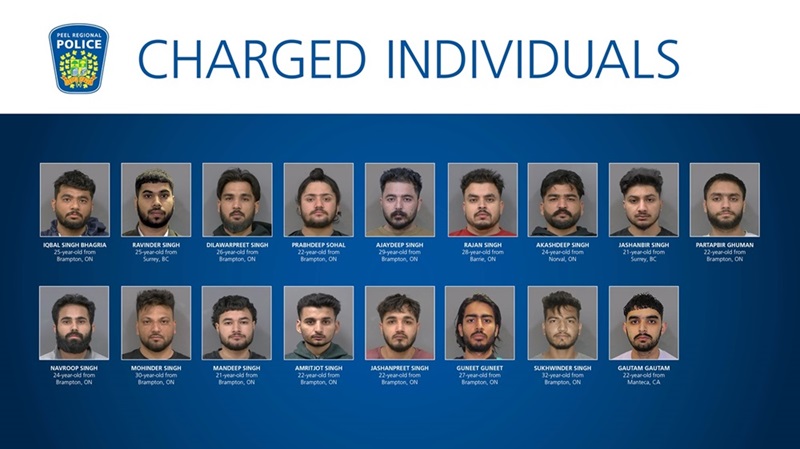
Recently caught gangsters’ henchmen.
8. ‘For Brothers’ gang arrested
The police are now considering ‘deportation’ along with arrests as their biggest and effective weapon to deal with this extortion crisis in Canada, because most of the suspects involved in these crimes are not Canadian citizens, but they are foreign nationals coming on visas.
Condition Meanwhile, Peel Regional Police have arrested 17 suspected members of another notorious gang called the ‘Four Brothers’, who were targeting South Asian businessmen. As of May 2026, the Canada Border Services Agency (CBSA) has opened a total of 446 investigations against extortion suspects, according to government data.
Of these, deportation orders have been issued against 118 people, while 55 suspects have already been deported from Canadian soil. Talking about regional figures, the most serious situation is in the Toronto area where 188 cases were recorded. After this, 132 test cases have been reported in British Columbia and 126 in the Prairies region.