
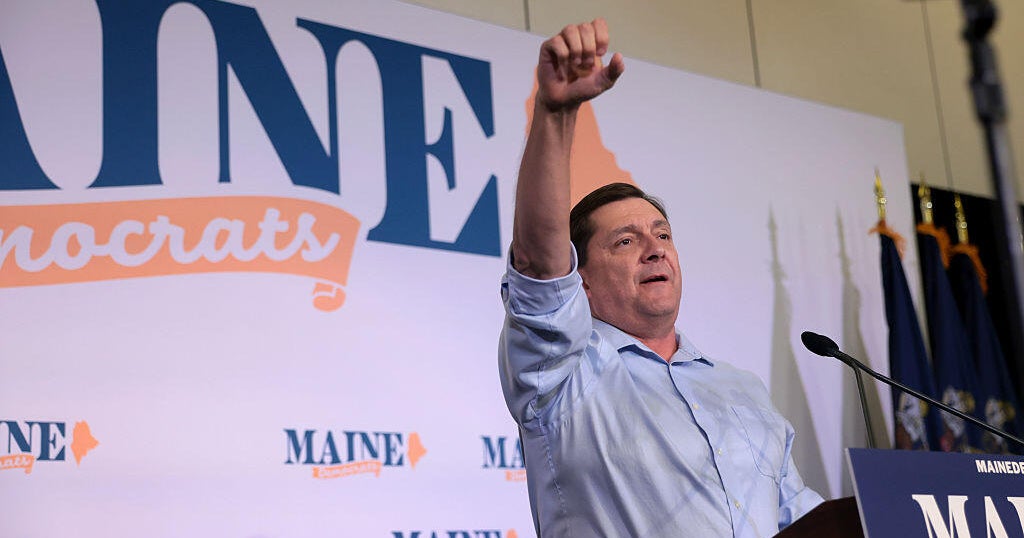
Washington — Maine Democrats on Saturday selected former state Senate President Troy Jackson as their new nominee to take on GOP Sen. Susan Collins in November, after Graham Platner dropped out of the race earlier this month.
With a 566-5 vote from the delegates, Jackson won the nominating contest handily, defeating lesser-known candidates David Costello and Saundra Pelletier.
“Power is never just given to working people. We have to band together and take it,” Jackson said during a speech on Saturday. “When the people in power refuse to listen, you have to organize, you have to stand in solidarity, together. And you have to make them listen.”
Joe Raedle / Getty Images 
Although about a dozen Democrats had jumped into the race earlier this month, after Platner’s exit in the wake of a sexual assault allegation, the field narrowed after last weekend’s county nomination meetings to select delegates. Jackson’s preferred slate of delegates dominated the elections, putting him on a glide path to the nomination Saturday.
The race’s other prominent contenders — like Maine Secretary of State Shenna Bellows and former director of the Maine Center for Disease Control and Prevention Nirav Shah — bowed out and encouraged the party to come together to defeat Collins.
At the nominating convention, delegates from Maine’s 16 counties cast their votes. And while the delegates on Jackson’s slate weren’t legally bound to support him, they were widely expected to do so.
What to know about Troy Jackson
Jackson, 58 and a fifth-generation logger, was state Senate president from 2018 to 2024, and previously served as a state representative.
Before entering the race for U.S. Senate, he ran for governor and was backed by Platner and independent Sen. Bernie Sanders of Vermont. Jackson finished third in the gubernatorial primary in June.
He’s generally aligned with Sanders, having also worked on his 2016 presidential campaign, and he supports progressive policies.
Short timeline for Maine Democrats
Platner’s departure from the Senate race triggered an abbreviated process to find a replacement. After winning the nomination in June, Maine election law stated that a nominee must withdraw by 5 p.m. on the second Monday in July in order to be replaced on the ballot, at which point the party has two weeks to select a new nominee.
Maine Democrats held the nominating convention to select a candidate with input from Mainers and scheduled it just before the July 27 deadline.
Now, attention turns toward the general election, as Democrats eye their long-held goal of unseating Collins.
Collins is the sole Republican seeking reelection this year in a state Vice President Kamala Harris won in 2024. But the five-term senator has overcome difficult reelection fights in the past. It remains to be seen how Jackson’s entrance into the race will alter the contest’s dynamics.
Platner, a 41-year-old veteran and oyster farmer, saw a groundswell of support in the early days of a campaign that positioned him as a formidable opponent against Collins. Through a series of controversies, including several problematic posts on Reddit and a tattoo that is widely understood to be a Nazi symbol — his supporters largely stuck with him. But when a woman accused him of sexually assaulting her when they were dating five years ago, which Platner denies, top Democratic leaders urged him to drop out of the race.
As Jackson prepares to take on Collins, his campaign said he had raised more than $1 million since entering the race, with over $600,000 of the total pouring in after his delegate slate’s broad victories last weekend. And his fundraising efforts will have to catch up fast, since Collins has more than $11 million in cash on hand.
Beyond Maine, the race could be key to determining control of the Senate. With 53 Republicans in the upper chamber, Democrats would need to flip four seats while defending seats in a handful of other close races to take the majority, in what has long been seen as an uphill battle. And without the Pine Tree State, Democrats’ outlook for flipping the Senate would be even more tenuous.