
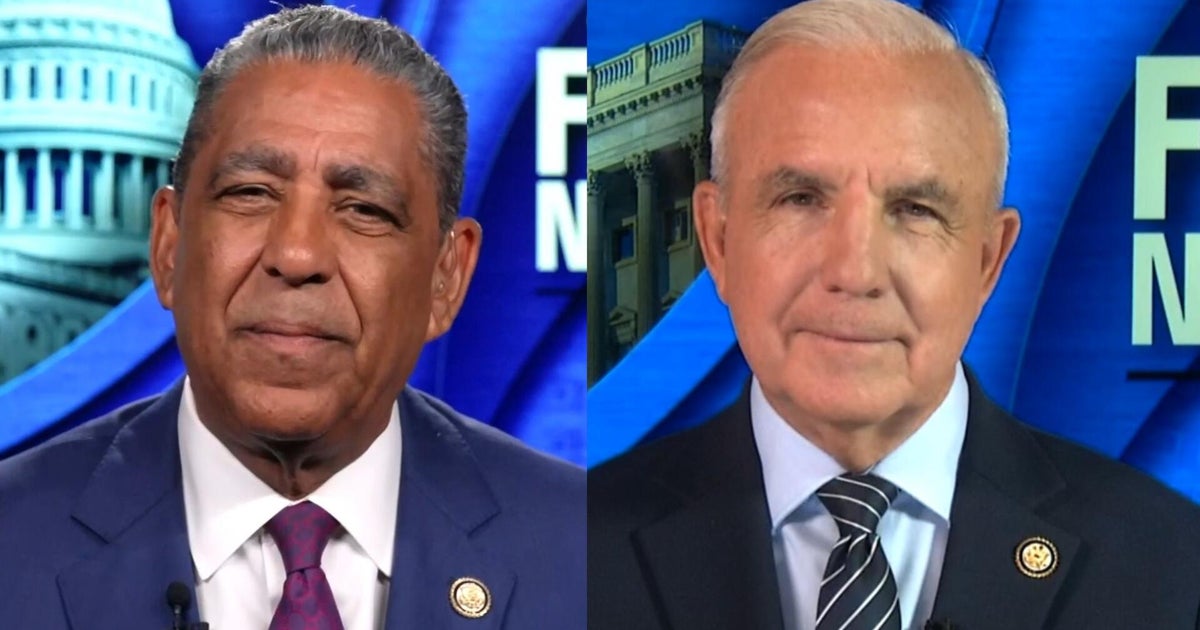
The following is the full transcript of an interview with Reps. Adriano Espaillat, Democrat of New York, and Carlos Gimenez, Republican of Florida, a portion of which aired on “Face the Nation with Margaret Brennan” on July 5, 2026. The interview was taped on July 2, 2026.
ED O’KEEFE: We turn now to Democratic Congressman Adriano Espaillat of New York and Republican Congressman Carlos- Carlos Gimenez of Florida. Congressmen, both of you, thank you for joining us. I want to start with you, Congressman Gimenez. You were almost seven years old when your family fled from Cuba at the start of the Castro regime. What do you remember about those early days in Florida?
REP. GIMENEZ: Well, I remember that we- we- we all went to one house. My uncle, my aunt were kind enough to take us in. There were about 21 people in that house, and I remember vividly my first day going to school. The day before, I went to, you know, they took me to a parochial school, and, and then the nuns saying that tomorrow was my first day of school, that was my first word in English. Until then, I only spoke Spanish, and so that, I vividly remember, and then the early days there, it’s like- it’s like a blur, obviously, you know, but- but, yeah, it was, it was completely different than my experiences had been in Cuba.
ED O’KEEFE: And Congressman Espaillat, as I understand it, you were about nine when you came to the United States from the Dominican Republic. I imagine New York City was a bit different back then.
REP. ESPAILLAT: Of course. The weather was cold, obviously. I remember the cold weather. We lived with our grandparents, who had a four-and-a-half bedroom- bedroom apartment in Washington Heights, and we got there in December, and of course, we went to school. Remember sitting in the back of the classroom, and for a year or more, not knowing really a word of English, but surely and slowly we- we acclimated, and here we are.
ED O’KEEFE: Do either of you remember your parents ever explaining why they wanted to become Americans?
REP. GIMENEZ: Well, I mean, in my case–
REP. ESPAILLAT: Yes, I- my grandmother–
ED O’KEEFE: Go ahead, Congressman Espaillat.
REP. GIMENEZ: Go ahead.
REP. ESPAILLAT: Yeah, my grandmother was the first one to become a U.S. citizen, and she was so proud of it. And I remembered that she spoke about it, about how great this nation is, and how it gave us a new opportunity of moving forward, but she was really proud of becoming an American citizen, and I think it translated then back down to all of us.
ED O’KEEFE: And Congressman Gimenez?
REP. GIMENEZ: Well, I mean, you know, look I was, I was seven years old. I mean, my dad and mom weren’t talking geo- you know, politics back then, but then later on, obviously, as I was growing up, I knew exactly why we came to the United States. We came to the United States, my parents were seeking freedom, not only for themselves, but for us, his children, my sister and I. To give us the opportunity to live in a land of freedom. I recall one day I asked him, ‘Hey, why is it that we came to the United States?’ a little bit older, and he told me a story about how I had come home and I’d asked him a question, and to him it felt like we were being indoctrinated, you know, into communism. And he- he decided right then and there that we had to leave because he wanted to give, like I said, my sister and I the opportunity and the freedom that the United States, you know, gave him, my- my mother, and then us. That’s the reason why we came to the United States.
ED O’KEEFE: And now both of you are in positions of influence and power as members of Congress, and there are, of course, all sorts of issues facing the United States Congress and the country overall. And one of them, of course, continues to be immigration, and we saw in recent days the Supreme Court issue a few decisions regarding immigration. I wanted to start with the one regarding birthright citizenship. The justices said that that is, in fact, guaranteed in the Constitution. The White House, however, isn’t entirely backing off the fight. The Deputy Chief of Staff, Stephen Miller, claimed ‘American citizenship isn’t the birthright of the world, it belongs only and solely to Americans.’ I’m curious, and Congressman Gimenez, we can start with you. How do you define American citizenship, or how do you define what it means to be an American?
REP. GIMENEZ: Well, look- what defines to be an American, I’m an American. I mean, I’ve been here, you know, the vast majority of my life. I think in English, and I love this country. I love this country because of the opportunities and the freedom that has been- it’s given me and my family, my children, my grandchildren. And so I have a deep appreciation of what America and the United States, you know, are. I agreed with the Supreme Court interpretation. It’s- it’s actually pretty- pretty well established in law for about 130 years. I also agree, though, that some things, you know, we need to do some things in Congress about this cottage industry of, you know, childbirth citizenship. Bringing, you know, mothers in just to have a child in the United States, and then them flying back. The founding fathers, or the writers of the 14th Amendment, I don’t think ever had that in mind. And so that’s something that we can- that we can fix. But if somebody is born here in the United States and they’re under the jurisdiction of the United States, which, if you’re here, unless you’re a diplomat, you’re under the jurisdiction of the United States, that’s the law. And- and so you know, I always felt that that challenge, you know, really was going to fail, and you know, I was- I was proven right, but we do have to- Congress does have to fix some of the things to make it more difficult for somebody just to come to the United States to have a child, to have an American citizen. I think that’s abusing the system.
ED O’KEEFE: Congressman Espaillat?
REP. ESPAILLAT: Well, the birthright citizenship is embedded, obviously, in the 14th Amendment, and the Supreme Court just stated that, although a very tight decision, but it’s been handed down to us. The Wong Kim Ark case, back in the late 1800s established that if you were born here, you were a U.S. citizen. And birthright tourism is minuscule, it’s almost nonexistent in terms of the volume of cases of people that are born here. 250,000 children would have been impacted yearly by- had the decision gone the other way. But citizenship for me, and being an American, is opportunity. I dream in English and in Spanish. What a great opportunity that is for anybody in this nation to have a shot at- at moving forward and to live within the parameters of what this nation offers millions of people. What a great nation. Still has hope and opportunity.
ED O’KEEFE: Both of you represent areas where there are many people under Temporary Protected Status, but the Supreme Court in recent days also ruled that about 356,000 or so people from Haiti and Syria are going to lose their TPS. And then that decision of course follows the Trump administration’s decision to cancel their temporary legal protections. The court did say, however, that it’s up to the Homeland Security Secretary to decide whether or not to grant someone status or end it. This issue is perhaps most acute in South Florida, given the Haitian community. Congressman Gimenez, I’m curious, what should the Secretary do? What should the administration do now with these hundreds of thousands of people?
REP. GIMENEZ: Well, I think in the- in the case of Haiti, without a doubt, you know, Haiti is a failed state, and I think that deporting Haitians that are under TPS, right now, back to Haiti would be a huge mistake. I mean, that’s the reason why TPS was established to begin with. Just like with Venezuelans, if Venezuelans lose their TPS status, which they have too, we should reinstate that, because of the devastation caused by these earthquakes that happened last week. And so, you know, TPS should be- should not be abused. TPS is what it says, temporary protective status, and if you’re here for a number of years, you should change your status from TPS to something else. But by the same token, it is meant to safeguard those that are fleeing countries, which are either failed states, and they would be at risk of going back to them, or countries that really can’t handle them right now, as the case of Venezuela, who is, you know, suffered a- a natural disaster and is having a hard time just maintaining the people that are there. And so, look, it- TPS, again, is temporary, but when- when it’s- when there’s good cause for it, it needs to be granted, and I think there’s good- there’s good argument for the people of Venezuela and the people of Haiti to have temporary protective status.
ED O’KEEFE: Is there any kind of congressional pressure, Congressman Espaillat, that should be put on the administration to try to stop them from sending back either Haitians, Venezuelans, Syrians, any of these other people who have come from countries–
REP. ESPAILLAT: Of course.
ED O’KEEFE: –with either natural or political strife?
REP. ESPAILLAT: Of course, it will be horrible that you send back people to a condition that doesn’t safeguard their lives. I mean, TPS really is offered to people that are in a country where there’s a credible fear for their life, or where a natural disaster has occurred, or their life may be in danger because the government wants to incarcerate them or harm them. And so obviously sending them back to a country that is run by gangs is horrible. Sending them back to Venezuela, given the conditions there right now after the earthquake, is also equally troubling. So, we must put all pressures available to ensure that that they’re not sent back, and that the mystique of our nation is preserved, which is that this is a land that will provide some help and cover and harbor those that are in dire need of help, because of a natural disaster, because of a dictatorship that wants to incarcerate them or kill them. That’s what America is about, and I’m happy that we can continue to advocate for this aspect of America.
ED O’KEEFE: You know, listening to you two over the last few minutes, I hear a lot of agreement in many ways, but you’re- you’re among, you know, you’re proud members of your party, and- and they have bickered for years over this issue, and we could spend the whole hour debating immigration, we won’t. But- but given your work and experience on this, given what you know about your constituents and where you guys have come from, what might be the easiest, fastest bipartisan fix Congress could make to deal with immigration? And in this case, Congressman Espaillat, let me begin with you.
REP. ESPAILLAT: I believe very strongly that it should be bipartisan, and of course, there are three particular items that I think are easy to fix. Dreamers is one of them. These are young people that came here when they were one, two years old. Many of them don’t speak the language of their homeland or have no connections whatsoever with the country where they were born, yet they’re Americans, but for one thing, a green card. It’s a fixed number of them. I think most people agree that they should be let in, they should be allowed to stay here. So, regularizing them is one. Farm workers, who- many of whom are not going to the fields to work because they’re afraid they’re going to be arrested and deported, and we need them. And then keeping families together is important, because a family that’s divided, that’s fractured, is a weak family, and many weak families make up a weak nation. So, these are three items: dreamers, farm workers, and keeping families together, and of course, TPS is part of keeping families together.
ED O’KEEFE: Congressman Gimenez, any of those on your list?
REP. GIMENEZ: Look, I agree with a lot of what, you know, the congressman has said. The problem that we have, look, the problem- the problem about immigration got exacerbated because we- the open borders that we had during the Biden years. And you had millions and millions- people coming into the United States, and it really drove the issue of immigration, you know, home. And I thought we were getting closer to some kind of a solution until that happened. The borders are now closed, and I’ve always said that once you- once you secure the borders, then we can have an honest debate about the people that are here, the immigrants that are here, those are undocumented. And I think that we can reach a solution. I think there was- there are plenty of people with plenty of ideas. The problem was that because of what happened in the last four years, you couldn’t even talk about it because you had to control the borders. Well, the borders are controlled now, and I think we need to pass something that says, look, ‘You’re just not going to have open borders.’ But now- now we have to deal with the people that are here. I don’t think anybody wants criminals to be here. I don’t think anybody wants gang members to be here. I think that people with active deportation orders, yeah, okay, but those that have been here for years, DACA is a great example of that, okay. And those that have been here for years, that have been working, are part of the community, that are part of the economy, we need to find a way to normalize them. Doesn’t necessarily mean that they’re going to be citizens at the end of the day, but to normalize them, so they can come out of the shadows, pay taxes, and then you know live their life without having, you know, fear of somebody coming up and- and taking them away after 20 something years, and separating from- from their children that they’ve had during that time, and so we have to find a solution. I think that the solution could be bipartisan, but it’s also seems, you know, when the Democrats were in control, it wasn’t- it didn’t happen. When we were in control, it didn’t happen. It’s got to happen. We’ve got- we- we got to stop kicking this can down the road. We got to have the debate. Everything, you know, whatever comes out of it, I’m sure, you know, the Democrats won’t like 100% of it, the Republicans won’t like 100% of it. And if that’s the case, if that’s the final solution, it’s probably the good solution. You know, nobody’s going to be 100% happy, and- and we can’t always- the one final thing is, we can’t solve the problem for 100% of the people. And so we can- we can solve the problem for 90% of the people. I think we need to make that effort, and then you know the other 10% you know, we’ll work that out later, but we- we need to find a solution to the issue of immigration.
ED O’KEEFE: I do, at least, hear the two of you saying perhaps the issue of dreamers, those young people, many of whom now are in their 40s, because they’ve been waiting for so long and have children of their own, might be the easiest fix. We’ll see if that happens anytime soon. Obviously, with the elections coming, it may not. In our remaining moments, and Congressman Gimenez, you got the first word, so we’ll give Congressman Espaillat the last word. So, we’ll start with you. What is your message to someone, perhaps Congressman Gimenez, that is on the outside looking in, who might want to become, who might want to be- come to the United States and build a better life? What would be your message to them?
REP. GIMENEZ: My message is to do it the right way. There are, you know, thousands of immigrants that are allowed into the United States every single year. Go to your- go to your- you know, in your country, go to the- the embassy, the consulate, etc. you know, and sign up to, to immigrate into the United States. Do it the right way, and- and then you will be welcomed with, with open arms. There’s a lot of skills that we need here still in the United States, even though we want to make sure that Americans get those jobs, but sometimes you know you do need skills from outside, and by the way, it’s not a bad thing to get new ideas, new perspectives coming into the United States from all around the world, because that’s what makes America the greatest country in the world. We don’t have uniformity of thought, we have diversity of thought, we have diversity of talents from many countries around the world, and that’s what made America great. And that will continue to make America the greatest country in the world.
ED O’KEEFE: And Congressman Espaillat?
REP. ESPAILLAT: This nation, as we celebrate the 250th anniversary, still has promise, and I think immigration has been a central part of our ability to move forward as a nation. So I ask those that want to come to our nation that this- bring your ideas, bring your innovativeness, bring your talents, bring your energy, the energy that has displayed itself throughout decades and throughout our history. There’s been no period in American history that has not been pushed by- by immigration forward, even in our most difficult times. It is the influx of new ideas and new energy that makes our country different, and of course, this is a great experiment, and everybody wants to come to America. Do it the right way. There are channels through which you can do it. We will continue to welcome people from all over the world. This is a nation that still has a lot to offer, is still relatively a very young nation, and one that I think has a lot of promise towards the future. I’m happy that my parents, my grandparents, who were both factory workers, brought us here to America. What a great promise. What a great nation.
ED O’KEEFE: Congressman Espaillat of New York, Congressman Gimenez of Florida. Thank you both for agreeing to speak with us this holiday weekend. We appreciate it. And ‘Face the Nation’ will be back in one minute. Stay with us.