
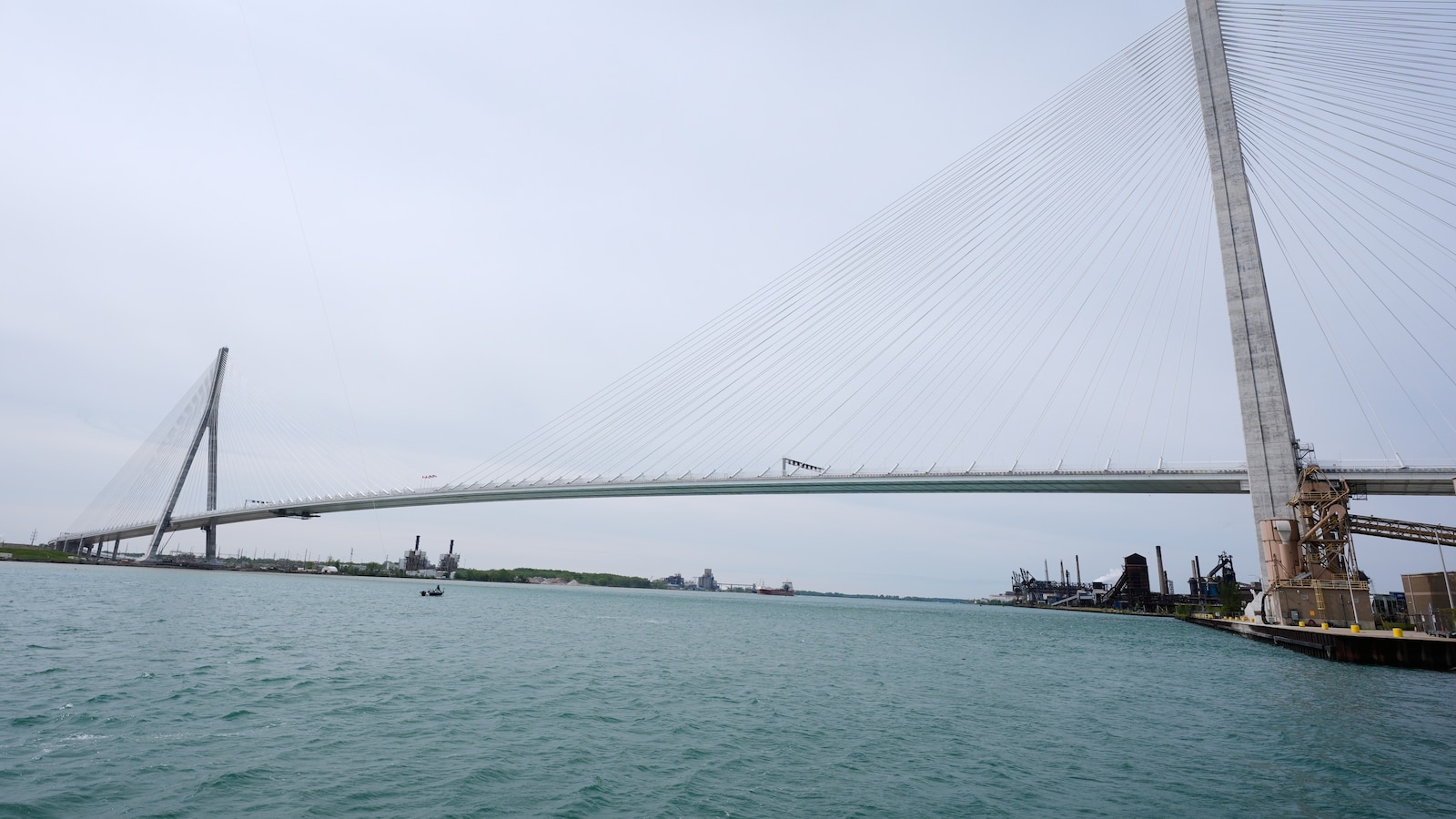
DETROIT — The strained relationship between the U.S. and Canada is spoiling the celebration of an extraordinary project between the two countries: a new six-lane bridge named for a famous Canadian who played hockey for the Detroit Red Wings.
After years of planning and billions of dollars in construction, the Gordie Howe International Bridge is ready for business, rising high over the Detroit River and connecting Michigan to Ontario.
But a ceremony planned for Friday, with dignitaries from both countries meeting in the middle, has been scratched after President Donald Trump this week announced 50% tariffs on most Canadian goods entering the U.S.
A spokesperson for the Canadian minister of infrastructure said joint festivities now would be “inappropriate,” though a separate event in Windsor, Ontario, is scheduled. The bridge still is expected to open to car and truck traffic on Monday, followed by pedestrian and bike crossings starting Aug. 5.
More than 70% of Canada’s exports go to the U.S., making America its largest trade partner. Detroit is the No. 1 port for truck traffic on the U.S.-Canada border, according to the U.S. Department of Transportation.
Those goods, especially auto parts, are worth billions of dollars. For decades, the only route for large commercial trucks between Detroit and Ontario has been the Ambassador Bridge, which is privately owned by the Moroun family’s Detroit International Bridge Co.
Facing a threat to its monopoly on lucrative tolls, the company repeatedly filed legal challenges against the Howe bridge, and even backed a 2012 Michigan referendum, but lost at each turn. Construction on the Howe bridge began in 2018, with Canada covering the cost.
Windsor Mayor Drew Dilkens said discussions about an additional bridge began after 9/11 when officials considered what would happen if the Ambassador Bridge were attacked. More trade was another reason. In the U.S., the bridge effort was led by Michigan Gov. Rick Snyder before he left office in 2019.
The Windsor-Detroit Bridge Authority, created by Canada, will operate the bridge. A recent agreement says Canada will share some toll revenue with the U.S. government for 15 years. Michigan will also get a share, but not until Canada’s costs are recovered, likely decades in the future.
“This will be the most technologically advanced bridge the moment that it opens, and it will give the most amount of certainty possible to the trucking industry,” Dilkens told CTV News in Canada this week, adding that “there’s a lot of excitement on both sides of the border.”
But any joy has been watered down, at least in the short term, by tension between the U.S. and Canada.
This week, Trump invoked a section of the Tariff Act of 1930 to impose 50% tariffs on certain Canadian products. The U.S. president accused Canada of unfairly discriminating against American autos, alcohol and dairy products.
Ontario Premier Doug Ford fears a trade war. Negotiations are expected before the tariffs take effect in 30 days.
“Canada’s been very, very tough on us over the years, for many years, and no other president’s done anything about it. … Without us, there’s no way they can survive,” Trump said in defense of tariffs.
Trump also knocked Canada over wildfires, which have sent dangerous smoke to the Midwest and East Coast, saying they were the result of forest mismanagement. Ford, the leader of Ontario, said blame from U.S. officials is a “shame.”
“Maybe they should pay us some damages or something,” said Trump, who, shortly after the start of his second term, even said Canada should become a U.S. state.
___
Associated Press reporter Joey Cappelletti in Washington, D.C., contributed to this story.